Wednesday, October 05, 2011

What I learn from technology - Distributed agency #Change11

I started responding to Jeffrey Keefers post at Silence and Voice that was prompted by Alison Littlejohn's paper for #changes 11 and would have said in response to the conversation occurring turning Alison's response on its head: can individual learning ever really exist? Things have to intersect dont they for new things to occur? But in such intersections, what other collateral realities are being done?

My pre-identified area interest in #change11 is to learn of the non-human actors, having committed to being an ANT groupie, and so following my own learning agenda- but having been touched y a collective learning forum of this mooc - i go off like Alice down another bunny hole...

Media literacies suggest the need for understanding that media has influence (McLuhan, Meyrowitz), and in education, teaching and learning understanding CCTs is to understand that they are more than tools (Turkle, Bigum and Rowan, Lanksheare, Bennet, Nespor)

Knowing what a techy does or can do lets me respond with more or less trust in the process.
Knowing of computer generated images means i make a judgement call on the veracity of what is projected. If i dont know how the techy has influence i dont make this call.
Manipulating the influence of the techy i can 'trick' others into believing things more or less. Used to be i could produce a word processed doc and my boss would be in awe- such days have passed :) But formality can appear persuasive.
In watching the Blair witch project, reality is conveyed by deliberately downplaying the polished product.
And so i would argue yes the technologies demand new knowledge, for they shape us.

The meme as discussed by Susan Blackmore http://www.youtube.com/watch?v=fQ_9-Qx5Hz4 suggests a cultural evolution has occurred, and the meme of technology is that it requires humans to breed....that which is imitated, and spread, a meme not an idea but that which is copied, imitated and altered as it transfers from person to person, why do they spread? because such meme ideas are selfish information that will spread if it can. So what is in the environment that makes breeding of new ideas more and less possible.
Is getting a new replicator dangerous- to carry an idea, getting a new carrier of knowledge is dangerous? Does google or other network engines shape what i have access to? yes.)

In teaching and learning, and in health, if i seriously take a web 2.0 approach, then i need to consider the influence of working in a participatory culture, wont that shift my expectation of not only what i learn...but how? Would it not also influence what assessments might be involved if assessment drives learning?

Is it dangerous to a planet to be so technologically shaped? Arguably it has done some horrid things to education. Globalised learning that can deny the import of local content. Testing of knowledge by MCQ tests because the machine can mark this. Teaching by ppt because it can be disseminated to the masses...
That my colleague can be made redundant because i can be teleconferenced out to four sites concurrently...

And for my own studies, what happens when the techy shapes the counselling, well it also shapes the roles as well as identities of those in the network. Passive actors are shown as much more active than commonly construed. If agency is seen as a distributed activity, how then also might this lead to altered conceptions of empowerment and of emancipation; to altered conceptualisations of what it is to learn collectively...

I dont have time for witty ness right now, nor for tidying up the blog today, this one's just another rough scribble
I have a conf paper that demands my attention, a deadline to meet.

Sunday, October 02, 2011

On being found by Schrödinger's Cat

Schrödinger's Cat >^.^<
No cats were harmed in the making of this blog.
Nor apparently in the following video....or at least not in my current universe.


http://www.youtube.com/watch?feature=player_embedded&v=IOYyCHGWJq4#!
Thanks to loadedphysics for this great rendition on youtube

The most commonly held interpretation of quantum mechanics is the Copenhagen interpretation[5] In the Copenhagen interpretation, a system stops being a superposition of states and becomes either one or the other when an observation takes place.... so looking makes it so >^.^<

In another galaxy far far away... the many-worlds interpretation holds both alive and dead states of the cat persist after the box is opened, but are decoherent from each other. Multiple realities/ distributed realities with no capacity to coexist. Just needs a timelord to travel between them...

Alternately: The relational interpretation makes no fundamental distinction between the human experimenter, the cat, or the apparatus, or between animate and inanimate systems. The cat observes the human, and not till the box is opened do the realities collide. The relational interpretation allows that different observers give different accounts of the same series of events. More than this though; for they live different accounts (or not as the case may be).
Distributed realities but with potential to talk between them.

And so yes, reality is multiple but does not have to be conceived of in the far far away type renditions.
And in the collateral realities of scientific research how come the cat is the one in the box?
How come the experiment is not about happy cat getting a cheezeburger rather than a bomb or radiation poisoning?
Where was the ethics panel and what were they thinking?
If the same experiment might even have been imagined in a way less harming to cats wouldn't that have been a better idea?
And why stop there? The box also has a position played out but not voiced in the typical scenario.
I note that blogger would not let the cat >^.^< appear in the subject line. Sometimes the technologies talk to each other and dont converse with the actors that those of us who are human centric tend to orient toward.

Tuesday, September 27, 2011

Live with Michael Apple

Live with Michael Apple
26 September 2011

[ these are my rough notes of his talk]

The state is not weak. He takes a pen and says this is the resource, if its this long…but neoliberals want half the pen taken away and put into private schools. This is not choice at an individual personal level for all.
Not everyone has choice equally. In my working life I can choose when I start stop. The other “Michael apple who also loves his son, but cannot drive across town get the child to the preferred school, pay in time and resource to get there…


Markets privilege the economically advantaged
They also privilege the male body, safety is not as even for girls, women, gay people

When you think of choice, as democracy it is a fiction.

A slippery sycophant of a word denying difference, denying gender, race, age,

Who has choice

His favourite quote surprises even himself, it is not Marx but Adam smith
Takes 500 poor people for every rich person
When god gave out genes white men at the front…
Front and back of line,

Who?
Cannot dismantle the masters house using the masters tools
Eg statistics

Decisions on whats good or bad, they have to teach the same thing or the measure don’t work, if they tech difft things get a regression to the median whether it works or not…if it raises test scores its good, neo conservatists love this

But in Canada, what is agreed on, what we agree on is we are differently positioned, what is common is the question
Rather than evacuating the curriculum lets deal do it

Cultural literacy…if a us/American kids..
What is common is disagreements, what is common ins the process of deliberation
We must have kids ask whose glasses am I putting on, whose knowledge s this
False consensus
What is common is that this nation is in motion


1st nation people, some stopped sasquatacwan, china,
policy smallpox vaccination, genocide
stolen people from africa dying before they got to montreal, Jamaica, new york they died
alice walker poetry (I think)
I will kill myself there is no I

Whose common is that, an African survivor
Politics that does not deal with the politics of voice
A changing population
With teachers who say this is not working daily
That destroys bodily understanding
Is not a curriculum at all it is an imposition
That lies of teachers, real children

Authoritarian populists, fundamentalists, increasing in Alberta is home schooled
And their curriculum bought on the web and says things like islam is the religion of the devil
And they believe teachers are worshippers of the devil
A final gp
Mohammed, sacred is his name, jesus, moses, people spiritual but do not believe in a man in the sky and to be honest I must work with the impoverished
The only way to restore order through the imposition of the religious

Go to stereotypes
A gp of people who enslave others

I think we have to speak out, it is something we should not ignore

New managerialists
If it moves in classes measure it and if it doesn’t measure it for it might

Performance pay is now the law in USA
Country of china has now also performance paid

If we can find good smart loyal teachers who improve good smart kids we will give them more money

Every nation who has implemented performance pay for teachers, has used it to fire teachers, not to pay them more

particularly, it devalues the wages of teachers who are working with disadvantage
Please vote against this

Its over why do u have to vote
I don’t have to say anything else
The smartest teachers in the worlds
In media
Don’t take the risk
Really nice people but you don’t have a clue of what is a good school but we will tell you

Two things for a strategy of interruption
1. the north must learn from the sth, Brazil a History of economic crisis
with influence of frère and Apple, teachers given more money because they had to work harder in a situation of 90% of children drop out in primary
that statistic now reversed.
Places with fewer resources than the north, with respect have to become our teachers as well
Places where kids can use the metaphor of putting on glasses to see whose knowledge it is that they are consuming, and to question this.

This becomes seriously crucial everytime I go to brazil I get stupider- I don’t know things- I watch to learn as coteachers and please be my teacher

2. simpler act- we in this room must become secretaries in everyschool teachers do unbeliebvable things yet press do not talk of this, teaching causes questing society u r teaching race gender…and we do not have the patience or money for this, you are creating unemployment, when the media say its all crummy lets attack it, it takes huge work to find what is being done well,
of all the books I have been involved in
best description of teaching I have ever heard; Gregory: I didn’t have time to pee, the best description of teaching I have ever heard in my life
a book called democratic schools, and asked by teachers to say…
and I understand this without quotes from Foucault, im feeling worn down, you must be my secretary I don’t have time to write it, but you must tape me, rewrite, make my successes known because I don’t have time to
democratic skills on 5 schools translated…

in the face of the blames and having to go out every day to change peoples lives there are things going on of which we must be immensely proud and our task is to keep alive the practice of the victory

There was a time in teachers lives in Boston in which there was a victory, you will be evaluated…a 19yr old young women on 6 months teacher ed said no. Let us say yes to keep Emma’s memory alive in our own bodies.


Liberals and the left have given me nothing but rhetoric but neoliberals will give me money, so there is no homogeneity, there are parts of poorer communities who accept therefore a neo liberal agenda. Caution needed in homogenizing groups.

Identity politcs no common ground,
Neoliberal would not be powerful without aspects of good sense…what is it about people’s lives that cause people to say this is broken, for some oppressed groups it is rediscovering who I am in a society deeply racist

If black or first nation person combination of class and race
And so identity

My solution to find a common agenda
A right to say, whether neo lib or otherwise there is a powerful sense of what is going wrongin whats behind the argument

Victories for some gps not others,
Im about controversies..

Friday, September 23, 2011

supervision pp phdchatters 7 spt 2011

what #phdchat ters talk of when they talk of supervision

Monday, September 19, 2011

mooc #change11

Ive some nervousness about this mooc having been in three previous moocs...

What i have learned from previous moocs:

1. I need to keep myself contained, moocs will take as much as you/i give them
and at this point in my studies and working life, i need to be setting my own boundaries.

2. Distributed learning- who and where is exciting and challenging, can work, but might be a tad too serendipitous. Because of this I'm really up front with my selfish/narrow area of interest.
BTW thats actor-network theory, how we are shaped as well as shaping when mediated through technologies

3. Change theorizing is a passion of mine grown out of discovering thwarted meglomaniacal tendencies (my own).
So Im very interested in seeing change in Machiavellian terms, or in a whirlwind model (Bruno Latour), or as messy (John Law)
And reject any top down or bottom up analysis.
Will entertain a thousand plateaus type approaches, rhizomatic descriptions are great, as are baroque folds, imho
Am willing to consider eco-system approaches (so long as they dont go too cosmic on me)
I just love the vibrancy that encompasses every actor in the network as well as the objects and practices that might be studied.

4. I set limits not only on my own area of interest but will also set limits here. This is a personal blog, its for my learning primarily, feel free to visit and to post, but dont write more than me- if you need a soapbox get your own blog and make a link :)


Enough for today; 30 mins on any day is the limit i am self imposing as ive a phd that is not writing itself.
But if you are interested in ANT, or in assemblages, baroque folds, or distributed agency and identity these are all areas that I love to engage on, so please do say hi!

Thursday, September 01, 2011

On being distributed

Seth Godin tells a story of Keith Richards telling a story of Charlie Watts and Mick Jagger
http://t.co/NP3mCCA

And it just goes to show that realities differ...

As told by Seth:
After a night of drinking, Mick saw Charlie asleep and yelled, "Is that my drummer? Why don't you get your arse down here?"
Richards continues, "Charlie got dressed in a Savile Row suit, tie, shoes, shaved, came down, grabbed him and went boom! Don't ever call me "your drummer" again. You're my ... singer."
No drummer, no stones.

Now if the drums had voice...
If we were a bit less androcentric...
If an ANT analysis was being undertaken, we might also have it said ...

You are nothing without me, you bang around as much as you like, but without drums you are no drummer


No drums, no drummer, no drummer, no Stones.

We shape our tools, and thereafter our tools shape us (Marshall McLuhan)
Identity is made in association

Sunday, August 21, 2011

silent protest - civil dosobedience


Pity but i couldnt get the photo from todays sunday star times, consequently there's mirror image reversal going on
A silent protest for the Ministry of educations lack of consultation on national standards.

Friday, August 19, 2011

mulling the phd; not procrastinating


I recall years ago reading a nice little magazine article (in the days when i still read magazines...obviously pre thesis)
It talked of it being a good thing your teenager was bored.
It then very quickly reframed boredom into having a thinking space.
Its the moments of not doing, that give time for contemplation.

So when Im spring cleaning in the middle of winter, replacing the curtains, vacuuming the ceiling, its because the ideas are fermenting. Just like a nice cider, it requires a little bit of time to bubble...

There's the possibility that
1. I do not want it to end.
I dont. I like being a student. And I like having this intensely selfish undertaking of depth. I want to graduate at the same time as two colleagues....I want to go to a conference next year that i could only attend with uni funding for a phd student...
However even if i finish next week, its still going to be the status of a student for a while so those arent very real excuses.

2. I havent yet found the cure for cancer *sigh* I havent yet scaled Mt Everest! I'm a perfectionist who want the best possible, that would be a problem, but unlikely. Dont think Ive ever been one before so its not likely. However i do not like failing, and i do not like aiming for mediocrity, I havent got anything worthy of a nobel prize, nor a booker prize, nor even an Australasian thesis prize. Its not a bodice ripping good yarn (yet).
My friend Heather would say just put on your ordinary...
apparently ball gown and bustier not required.
And Bruno Latour says a good thesis is a finished one.
Many dont....mine will. I know this.

3. I havent suffered enough.
I havent. I dont hate it. At times this is too easy...maybe i have enough now but it doesnt look hard enough.
My little contributions to knowledge do not feel grand.
Sure ive studied something no one else has. Its new in the world. Others might want to know more of it.
And ive a tiny inkling that with distributed agency is distributed responsibility so there's a tiny bit of newness for a theory
And the methodology supports some brave new world stuff on the research processes of working with young people and with sensitive research.
Are my molehills big enough to constitute "new knowledge"
As with no.2....might just need to pull my head in and be satisfied with being a modest witness, a modest contributor....even some of my fav authors are this. They do not come across as earth shattering, so i too should stop trying to shatter the earth.

4. If i finished i would have to play with the big girls and boys in academia contesting funding...
I dont have to. I could publish the smaller things. I can hold it together when its short bursts on a theme.

5. My angst, confusion, curiousity are sated. Having satisfied my curiousity, its boring to retrospectively write the story of my thinking for others...especially if its only going to have a minute audience *sigh*
And i have already fed back to my site of study...and was well received...but is still owe them and the participants of this, completion.
Also there's the scope for what i talk of to be useful for others...and i know it wont be if its not finished.

6. I have writers block. Except i dont. I can write this. What i have are thoughts still growing: mulling. Rereading and editing makes the direction for conclusions a little more cohesive. I keep a rough doc of conclusions in progress: i write them as they bubble... a vat of mulling thoughts to draw on.


7. Twittering has been useful. This weeks twitter #phdchat provided an opportunity to consider what are the hallmarks a a phd's unique contribution to knowledge. The earth does not need more shattering a modest contribution will suffice. (thankyou Jeffrey)

There is uniqueness in what i have studied. There is also uniqueness with how i have gone about this. There is a glimmer of possibility in provoking further thought on the philosophical underpinnings of my methodology. And there is the application of working with sensitive research in a way that is respectful.

The feedback received to date suggests also that what is contributed is useful in affirming and nurturing nascent practice. Such practice being valued when considered in terms of having voice and being heard.

I have not left the world or what i studied, in a worse state than i found it :)

Sometimes i have looked at fabric and thought that it would have been better left uncoloured ... i have also looked at what is written and sometimes think that editing down to the blank page would have been desirable.

I look at what i have written and believe i have improved upon the blank page.

Earlier in my studies- a year ago exactly, I was immobilised with fear of how what i study might be misrepresented, used to rationalize horrid practices. My conclusions will include this, or at least the vat of thoughts shall. I cannot control where what i write of might lead, but i am still alive, i can still respond, I continue even when he phd is done. There is accountability/responsibility and distributed agency that points to this. I just dont quite know how to write of it (yet). But its firming up, congealing, clotting.


Wednesday, July 20, 2011

Distributed agency, some messy thoughts

To be dispersed, scattered, shared around, fractional, partial, apportioned...
What does it mean to have agency distributed?

To make changes involves a networked world...inside of which what i want to have happen pushes and pulls on others and vv...as a consequence, what actually happens is a result of contingent relationships and may or may not be what i wanted, or you wanted, but something inbetween...points of tension. May even be what neither of us wanted or expected...and the effects of these contingent relationships, of push and pull (sometimes politely referred to as negotiations and sometimes much less pretty than such a term implies) are sometimes not immediate but way down the track .... I could trace the Guttenburg press and mass literacy to twitter...
In this network of involvement are not just people but things also...widespread literacy needed cheaper ways of making paper, and means for making ink...

The outcome of this tussle, of push, pull, of people as well as things, is something that happens because of a distribution of agency, of things with capacity for altering what is, things of force.

(At this point philosophically it would be good and proper to acknowledge my thinking having been shaped through my reading of Latour, John Law, Lucy Suchman, Annemare Mol).

Where i take this a bit further is to consider then that responsibility and accountability are just as distributed.
Our individuation being a creation of habit rather than of actuality; again a form of thinking that is normative- distributed.

Here are some textual musings from others on our mutual involvements:

Latour writes of the hidden masses of myriad beings
McLuhan tells us the medium is the message
Mol's conceptual analysis: being more than one and less than many in the body multiple
Pickering's mangle of practice
Turkle invites us to think of the things we think with, evocative objects
Lucy Suchman (bother the person who recalled her book on me, but that just goes to show the push and pull)...
Kaen Barad "agency is not an attribute but the ongoing reconfigurings of the world."
John Seely Brown; the power of pull - pdf of his keynote http://web.nmc.org/files/2010-summer-conference
(and the effects of blogging this then had me search for his work some more, finding an article on why the virtual matters...)

And some visual considerations:

The experience of distributed learning on a mooc by Gordon Lockhart http://gbl55.wordpress.com/2011/03/08/cck11-man-this-mooc-is-something-else/

The internet of things Courtesy of Cisco ISBG

Need to do some tidying up of this post, attributions as well....
I'd never have got here without my enrollment in a Phd and the people therein,
And the making of a phd is also distributed: the attributions and acknowledgements go nowhere far enough in recognition of this...
but also I could not have got to this without a computer...many more attributions could/should be made...mobile phones...the use of sms...the use of twitter, this blog...
But my time is a bit partial right now also...

#phdchat for a visual representation this site will do a graphic of twitterings http://ouseful.open.ac.uk/twitter/friendviz.html?q=phdchat%23
And for further food for thought, nurturing ideas comes from such places...distribution in a very organic way... some Latour and Sloterdijk on spheres as well as networks, where the tensions on spheres also produce some things that might be nurtured, in a world that may or may not be ready...tensions might or might not establish such space...

This is "rough as"
"jagged even"
a smoothing out comes later, tracing backwards allows for this, moving forwards less so...
a trajectory is so much easier to trace afterwards.

So its now a day later...and i add some more...and then a month later prompted through a tweet i think i should tidy it further...
so back to what does it mean to be distributed...to have agency distributed...what i can or cant make happen...
in what Law might name a hinterland of possibility....one you just entered...your touching this thread spreads the points of tension further....distributed.
And so i continue to mull it over....and you might too now...

how are the tensions caught up that make some things more or less possible,
the resources available,
the sense of "freedom from" and "to do"...
who has push and pull,
what or who is seduced and/or betrayed ,
what promises are made, dreams sold? Who are the purveyors, whose interests served?

What does it mean to be distributed?
of what materially,
and of what i can or cant do because of it- herein lies agency,
but perhaps also responsibility.

Not in the sense of blame as much as it is about
the state or fact of having a duty to deal with something to continue to work with something
a moral obligation
of being accountable

A responsibility to act moving forward?
vs accountability to justify what happened in a past without knowledge of the future....had i known i would have...?

I fear i could do a further decade on this and still be dwelling on such questions
:) could be a lifetimes work such questions!

Monday, July 11, 2011

How did a telephone insinuate itself into your life?

When i was pretty young I remember our house getting a phone.

It was a black wall mounted model and I remember there being a telephoneman that established its presence. I remember needing to remember my phone number, it was to be as important as remembering my name and my address. I wrote it on the wall in pencil in case i would forget...it was 82029...i think i wrote it on the skirting board in pencil with the twos going backwards, i think i may have been 4. It may have been about 1963.

It was placed in the hallway near the front of the house. As if to acknowledge its intrusive nature, it needed a space of its own such conversations could occur in a non intrusive way.
Or perhaps it was near the front of the house as acknowledgment of it being a point of entry for strangers.
Im struggling to remember where others in my neighbourhood had their phones, but my recall is that they were all in hallways.
They were answered with such formality, the number was recited, or the formal statement of who one was talking to; "Mr McLaren speaking" as my father would say.

I also remember shouted conversations where plans had to be negotiated between people in different parts of the house, or someone being told to 'hang on'.

It was at least 15 years before my family's phone intruded into the living space of the kitchen and a little ways later before a second phone entered into a bedroom.

I note in saying this that ownership of the phone shifted, it became 'familial'. No longer attached to the house, but more to the household. It was no longer an appendage of the house, but a shift occurred in seeing it as a possession of the family.

Being a child of the 60's and 70's i recall the staying home and waiting for a phone call...
I also recall 'being prepared' included having money for a phone call and at Guides there would be inspections for what was in our pockets...seemed string and phone money were requisits...not quite sure what I'd do with the string...
But I'd ring home to say i was ready to be picked up from the red phone box on the corner...I'd make a call and when someone at home answered, i'd need to press button A to talk, or if no-one answered press button B and the money would come back...

It was in the 1990s I remember ringing my brother in Aus and being surprized by his saying he was at a neighbour's pool party talking to me on a cordless phone...am pretty sure my jealousy had more to do with the pool but also surprize at the range for a phone.

It was late in the 1990s when my partner got a mobile phone, a weighty thing by todays standards, but so much more portable than a 'landline' of the times....several renditions later before it could be worn unobtrusively, but nonetheless an excuse for the posturing of here's mine, placing ti on a table. Not they rang so often, but a status symbol of importance: im needed anywhere anytime. A yuppie thing.

Several renditions later, a discrete object that was to be on the person of every member of the household...or at least on any member of the household old enough to go out by themselves. It became a way the youngest members could go out more safely
More recently it became my way of paying for parking, my address book, my torch, my watch, my alarm clock, my appointment diary...its as close as my handbag and it goes most everywhere with me.

The phone boxes have modernized somewhat, but Im now always surprized when i see someone in one.
And the landline home phone fixture seems to be going the same way.

What i would like to know is where were phones were positioned when you were growing up?
Please tell me the stories of phones entering into your life.

Here's how music positioned phones in changing cultural contexts...


Sunday, July 03, 2011

The one hour PhD, and other variations

Having spent 5 years on this so far, and a yet to be edited down to 100,000 word thesis, I feel more than well enough qualified to consider, and to write on, the one hour PhD.
My credentials include:
PhD in txt speak (160 characters)
A PhD in a tweet (140 characters)
A PhD haiku (roughly three lines and 17 syllables)
The three minute thesis
A PhD in plain English (for the intelligent "aunty")
The lolcat thesis
And an origami exercise in thesis writing relating to worldmaking


And now I have a new diversion: the one hour PhD.
This one's based on how to read a book in an hour, a useful consideration given I'm entering into my final year of my study (I hope) and have suddenly found books I wish I had read at least 4 years ago...
This however is not about the reading of a book in an hour, nor for those hopeful is it about the writing of a thesis in an hour.
I write of how to present the thesis such that it could be absorbed, if not "read", in an hour. A useful consideration for editing the product of several years of study. It's also a way of putting a smile on the face of a reader, its about a sell job- they are getting nothing less than what was promised and hopefully a whole lot more.

So a rubric to edit to:
1. The title, 10 words. If a word search was going to pick this up in a data base would it have done so?
2. The introduction, 10-15 pages saying what you-and-the-reader are getting into, and what you-and-the-reader will get out of it.
3. Outline the book. Is it evident in the table of contents? Do the chapter titles as well as headings and the first level of subheadings (if any) provide a map to the thesis argument? Alternately it can be a perfunctory outline of what a reader can anticipate of the order.
4. Check opening and closing sections of every chapter. Do these provide enough info to understand the main points. Would a cut and paste of these *and nothing else* make sense in progressing the argument?
5. Does the conclusion progress from the introduction? If the intro and conclusions were bookends, are they balanced; do they match? If it takes the reader somewhere else, has this been explained? What of the argument or journey is highlighted? How does this contribute to new knowledge? What does it contribute to practitioners, to the theory underpinning the study, to future researchers?

And then there's the bits in between...but that's the subject of the other 5-6 years of study time...and for that you actually have to write the book :)
...and read it.

All seems so clear when i put it like this...makes me wonder what i have spent so many more hours on...but then there's the thinking time...and the writing that makes it enticing, a pleasure to write and to read...

Wednesday, April 20, 2011

phd procatsination: lolcat tells it like it iz

Here is my lolcat thesis conclusion

And here's the story of my progress on the thesis, though the lolcats here are not my own, my story resonates with what is told in these pictures.
I am all over the place but dont know it
The topic is teaching issues of heart and soul using IT (information technologies)
And Im searching for a place to hang it,
I settle on a uni, one outside of NZ, write a proposal, thats all over the place, huge, but enthusiastic.
I get a supervisor appointed and we establish some shared interests , we both like Macs, we both read some of the same people, we both know some of the same people (NZers are known for only having 2-3 degrees of separation)
I read for a year. I get used to endnote. It does not get used to me.
I get familiar with technology. Some of it gets familiar right back. (i find i get adverts tailor made to my searchings...i get stalked by cyberbots and cheap marketeers on my blog...and just now there's an option for turning the blog into a book...dont think the coherence would stack up for the markers, but its a thought...)

I'm on bebo, facebook, twitter...
I write a plan, annually i repeat this step in creative writing, I tell myself it doesnt matter, its a fiction. Ignore the timelines, but oddly, retrospectively, and with no intention at all, I see they are actually reasonably accurate.
I write a colloquium document,20,000 words.
I write through writers blocks about whats blocking me establishing the need for the research, scoping relevant literature and a research method and demonstrate knowledge of the ethics involved. I have tentatively approached one of the three places i wish to undertake the research. I want to compare and contrast them.
At my verbal colloquium (two profs, two academics,three internal to the uni one external) it is put to me that it is to big. I argue it is the contrast Im interested in, they suggest again we might rework this as i progress.
I keep reading, I attempt the multiple ethics applications, multi layered,internationally, and come to a grinding halt. Its too big. argggghhhh
My supervisor talks me through options, i dont see the wood for the trees. I'm so glad he can. I recall a conversation about which of these is the 'cure for cancer' and where do i want to be positioned into the future.
I make a choice to study change and a voluntary organisations use of emergent technologies.
Knocking it back to one site of study i do an ethics application that is still huge, still multi layered but only involves one site. Phew. And then i do it again for a NZ ethics committee. Its huge, its persoanl, private, involves children, involves children without parental permission, it involves artefacts where consent was not explicitly sought. Only alarm bells not hit are working with human remains, radioactivity or genetic modification.
All this fussing over...text messaging...

Bilingual thesis?
I read and read and write and write and data collect, exciting times, intellectually.
Socially i suspect i become more of a one track conversationalist. I'm glad i have friends similarly narrow minded. We take turns in talking our narrow fields.
And here's where i stay for a long time, there's a lot to read, a lot to write, and im waiting on getting a 360 ish data collect with particularly ethereal research participants to come forward. They eventually do.
Meantime I now have a multi levelled tangled mountain of threads of data to work out what to do...
Tangled mess of data.

I tease out threads, I read, i tease out threads and read and write, and find some ways through and into to sort this knotted mess of tangled thoughts and observations and everything.
Putting the world into words is not easy. I blog bits of this.
I write of some of the threads followed, and i find literature that similarly writes of such messes.
I have lost my soul to this tangle

The writing progresses. I have an intro. I have a perfunctory and boring lit review.
I have a research method. I have data. I come back to the boring lit. I rewrite and rewrite. I eventually find an article that helps rewrite this so i hate it less. I do wish that writer had written that article earlier, but if he had i suspect i still would not have recognized its value... the rewriting puts a new spin on the latter stuff, i rewrite the latter stuff... finally the process feels iterative. Ive heard its meant to be and am now feeling a bit more confident that I'm doing something that works, something others describe as normal.
Im less pushed around by what i fall over, Im less reactive to whats possible.
I have more control on my world.

I have a clearing sense of what it is thats new, of what i did and why, of how i did it and can justify this. I wish these writers i love would stop writing, i havent yet got to the top of the literature mountain and there is stuff i would like to read more slowly, stuff i would like to read again. But i need to write, there is a timeline.
I am becoming discriminatory in what i have time for and what id do not. I thought i had this before, but now its much more decisive.Im getting a bit OCD, But Ive got it sorted.

I write too much, There is a word limit and i can see i am going to go over it. I work at killing my darlings,
the words so carefully crafted. Iteratively i recheck whats before so that whats left out no longer matters. There is a blurring. the document writhes as i try to recall whats in whats out, i know ive written stuff but where...i try to keep an unruly pack of cards stacked and fantasize handing in a snowglobe of paper where order doesnt matter.
But then i realize its just about folding the world differently.

World making is what it is.
I keep writing.
I have about a tenth more of methodology to do, about a tenth more of data to be played with
And then conclusions, about three i think, short snappy one...reality i have learned is multiple, and so for my endings.
Meantime i am more sedentry than ever, the brain is active, its had a major workout, so has the soul, meaning of life... the body not so much...


An exercise in worldmaking :)

Sunday, April 10, 2011

A thesis in almost plain language

Attempting a plain language summary of my study as suggested in phdchat# and role modelled by @lizith, @OrgMotivation, @martin_eve and @jennacondie,and @claretCarly

Its an interesting assignment, one i have turned to my own ends. Since I am studying the use of change with emergent technologies in a youth counselling centre, and since young people appear to be changing this service from the outside in by using text (SMS) messaging as their preferred means of making contact with the organization, I provide a summary of my thesis in txt spk.


when kidz txt a helpline
wats goin on?
who & wats involvd?
wuld u? culd u? shuld u?
dunno?
This thesis looks @ changes @
Youthline NZ: a crisis helpline
4 young peeps


Now for the less succinct version, where i try to be clear, but its not quite plain, I'm still attached to certain turns of phrase.
Change and the use of emergent technologies in a NZ youth counselling centre


This research focuses on the relationship between how people think about change and what they do to enact it. This is explored with reference to changing health professional practices where interpersonal interactions are increasingly mediated through computer and communication technologies. In investigating the use of new and emergent technologies for counselling the study traces how the work of counselling is reconfigured, and how relationships of those involved are negotiated.

The site of study is a not-for-profit organisation, Youthline (Auckland, NZ). When this study begins the organization is providing telephone counselling predominantly through its crisis helpline. At the start of this study there is a constant buzz of phones ringing and of counselling conversations occurring. Over the course of this study the phone rooms become almost silent. Youth still have problems, and still seek help, but increasingly this occurs silently. This study investigates what occurs as counselling moves into the silent and small space of short message service (SMS) or text-based mobile phones.

In providing a text-based helpline since December 2004, this organisation becomes a world leader in the practice. There is presently no evidence base for this practice and while this study does not address the effectiveness of such interventions, it does consider factors making the practice more, and less, viable.

The analysis is undertaken within an actor-network sensibility. Actor-network theory (ANT) emphasizes relationships held, dissolving and evolving between actors whether human or otherwise. This study investigates how the actors involved, human and otherwise, are performed in, by, and through their relationships.

Performances of change and the use of text-based counselling are presented as short narratives, slices of practice, telling of contingent relationships. Eliciting these narratives included interviews, artefact analysis and observations of practice, over the course of two years.

The performance of such stories provides partial and decentred ways of knowing. The use of the word partial is deliberate and relates to more than one meaning. The stories do not, and cannot, encompass the whole. In addition, such stories reflect the author’s own partiality. “I” write a text composed of slices, where such slices of stories sometimes sit alongside one another, but which more often intersect and which sometimes clash, reflecting the precarious reality this thesis depicts.

A tangle of constitutive relationships are shown to embed mobile phone use and texting in particular, in young people's daily lives. In analysing the tangle of contingent relations making text counselling more and less viable, the intent was never to prove text counselling as good or bad, but to know the uncertain and revisable nature of text counselling as practiced. Opening up text counselling allows us to see how this practice is shaped and might be shaped otherwise. Specific strategies for strengthening the work of this not-for-profit organisation are then able to be made explicit.


I really would appreciate some feedback on this:
1. Should the txt spk version be the first page of my thesis?
2. Is the longer version clear?
3. Any other feedback also welcomed :)

Sunday, April 03, 2011

Actor-Networking / Artist Networking


I became interested in this art as a result of two presentations given by Bruno Latour, where one of his ppt slides used the artists work. Annoyingly these videos that i had previously linked to, and which ANTHEM had linked to are no longer on the server.One is still accessible here: is http://www.aaschool.ac.uk//VIDEO/lecture.php?ID=1380

What is also odd is the difficulty i have in tracing how i got to this artist Saraceno this morning, i cant recall the trace of how i got to it, searching my history in firefox doesnt do it. I am left with holes as big as those in the imagery: the gaps in the digital trace of my net surfing as well as wondering how can i be so forgetful when I'm only talking about half an hour.
Odd how ethereal such traces can be.


The artist is Tomas Saraceno. Images on a google search are here


Now to network in my computer clever one to rip it...

Saturday, April 02, 2011

A thesis txt spk: 2b/not 2b?

I'm finding voice, and negotiating whose voices gets heard in the thesis.
Mine own being one part of this.
Since a major component of my thesis has been the take over of a youth counselling network by text, culd i jus txt?

Seth Godin states

"My take: the smaller the screen, the more hurried and less informed the decision ends up being.

Yes, there's more currency, more immediacy, more with-you-right-now-all-the-time and more data being collected. But......

If you're working with a spreadsheet or a thread of correspondence or a set of data, I'm not sure you're doing your best work if you're doing it on an iPhone."

Seth

Guess that's why the phd wont be submitted in txt spk


Nonetheless,
the writing off a medium as less useful for good works is a bit offhand.
And Godin uses twitter himself to point to very short blog postings.
The good works still occur.

But what is useful here is that he has identified consideration for what suits from what does not.
Some digital literacy is called for in such choices.
Lankshear and Knowbel, challenge understandings of literacy and of digital literacy especially:
texts evoke interpretation on all kinds of levels that may only partially be ‘tappable’or ‘accessible’ linguistically...The significance of the new technical stuff largely has to do with how it enables people to build and participate in literacy practices that involve different kinds of values.

An appreciation then of media effects, in what ways are values reshaped?
Leads me to consider questions of power and influence, and to know how technology has influence.

Or to use Kevin Kelly's phrases, its about having consideration for what technology wants.
And then negotiating this.

A first step would be to increase awareness of what technology asks people to do; so I have listened for it. And being informed by Bruno Latour's Actor-network approach, I interview the technologies involved: Have them submit their cvs, ask them about their best practice, do some performance based questioning, and some performance review in observing practice

And following wot apears to b a hostile tkeova,

The thesis i am negotiating wnt b
txt spk

wuld b 2 tight & probly trite

:-#

2L8

Friday, March 18, 2011

Storytelling: writing a thesis


Once upon a time is a much more interesting narrative than thesis writing, where typically the format follows: this is the problem, this is how it is addressed, and here's what was found, and therefore this is recommended.
As an example:
This study into what went wrong found little red riding hood set up by her mother, duped by a wolf, saved by the woodchopper, and at the end the wolf is dead, but so is her grandmother....but lets not dwell on the negative. Although we may also have some recommendations about childcare that could be the subject of another thesis.

*sigh* The only reason that would work as a bedtime story is because it would induce sleep.

The absence of thrill in academic writing is the subject of a blogpostand a twitter link by @andycoverdale who cites Jonathon Wolff's article titled Literary boredom
Rather than fostering excitement, academic writing styles give the plot away on page 1.
A peculiar attribute for avid readers, is it that academics have to read so much they need the last page first?

Could a more engaging narrative be written as a thesis?
This could be serious, if its to change something, and don't all thesis writers set out to make a difference, then it cant do that if no-one reads it.

Option 2, turn it into something more thrilling in your post-doc life.

In considering the story rather than the plot... it is possible for a thesis to engage otherwise, it does not have to be situated in a netherworld of absent authors and distanced readers, cancelling the distance between reader writer and subject matter is what Patti Lather writes of in academic speak.

In their 2004 book, Storytelling in Organizations, John Seely Brown, Stephen Denning, Katalina Groh and Laurence Prusak explore how narrative can be used for transferring knowledge, nurturing community, stimulating innovation and preserving values. These are things I want my thesis to do. Surely it is possible to get there without being dull?

For Latour also, it is in the story telling that uncertainty resides. If the story doesnt engage, an ANT analysis fails.

But if a thesis doesnt follow conventional wisdom, might it fail also?
A point of tension: do I take the risky exciting path that might have wolves?
Or the path where the wolves are dealt to in advance?
The latter is obviously the safer option, these academic types dont seem to want surprizes...we save those for our children, ironically to help them sleep at night.
How strange is that?

"This dark telling is of a young girl with a mother whose stretched too thin, sandwiched between providing care of children, care of aging parents, and wriitng a thesis,but soon the daughter finds she has far more important things to worry about than lack of dinners on the table and having to take sandwiches to her granny. When people start turning up dead with their throats ripped out, she begins to suspect her Granny may be to blame."

Now to write my own thesis review: A great story bought back to life by interruptions to the thesis narrative.

This leaves openings for further study, perhaps a gendered telling...where's the father in all of this?
Or a feminist marxist one...exploitation and inequality in the divisions of labour
Perhaps an empowerment narrative might leave less bitterness? But heh, just whose reality do we work with here? This is not a happy telling for any of those involved, wolves have to live and eat too, and are probably an endangered species, the mother's worn out, the young and old neglected, and the woodchopper- please tell me he doesnt get to carry off the child or Im going to have to get concerned about further dubious and exploitive relationships...

Perhaps, having written out my angst I should now return to the endeavour of writing for the staid audience of thesis markers.

References
Lather, P. (1997). Creating a multilayered text: Women, AIDS, and Angels. In W. G. Tierney & Y. S. Lincoln (Eds.), Representation and the text: re-framing the narrative voice (pp. 233-258). New York, NY: State Univeristy of New York Press.
Latour, B. (2005). Reassembling the social. Oxford, England: Oxford University Press.

Thursday, March 10, 2011

If knowledge is distributed, if agency is distributed then what of accountability?

Today Frances Bell and I gave a presentation on CCK11 about networking power and authority.

Cant wait to see the capture off eluminate, the audience was great, and i want to read the backchat, attending to the whiteboard and the microphone, meant i didnt always follow the chat...
These are the slides used.
Below them are the notes, some of which i referred to during the presentation and some which got lost in ...association.


slide 1
An invitation to talk to cck11 through George Siemens and Stephen Downes.
A joint presentation was then negotiated between Frances Bell and myself to explore issues of actor-network theory, connectivism and power.
There’s always some networking that goes on behind the scenes, Frances and I have never ‘met’, there are things made more and less possible through courses such as this.
NB the haiku was used by Lennie, I. (2003). Managing metaphorically. In S. Linstead (Ed.), Text/work : representing organization and organizing representation (pp. 41-56). London, England: Routledge.


slide 2
Things, matters of concern, even ‘facts’, even gender… Simone de beavoir being ‘made a woman…identity…all get made in association
de Beauvoir, S. (1974). The second sex (H. M. Parshley, Trans.). New York, NY: Vintage.
…means identity is fluid and also, roles fluctuate.
The haiku only possible through translation, when this and that go together some things are gained and some things are also lost.
In change resistence will always be met, as what is drawn in may need to establish a niche, and may not want to leave where it was settled either.

slide 3
There’s talking politics and being political Bruno Latour.
Any movement in the network meets resistance, always there are issues of power, control, authority, acquiescence.
Movement in one part creates movements, ripples and even ruptures elsewhere.
Just as identity is made in the moment, so too is everyone elses identity.
And because this is actor-network informed analysis, it also acknowledges that being shaped in association related also to how people are enmeshed with what they make, and what they make is enmeshed with us.
Wesch, M. (2007). Web 2.0 ... The machine is us/ing us [Audiovisual ]. Retrieved January 16, 2011, from http://www.youtube.com/watch?v=6gmP4nk0EOE’ the machine is us/ing us is relevant here.

slide 4
Given we are looking at power/control/knowledge and how this is shared or not…we have an opportunity in terms of form and function, where do you see this as relevant, and so participants could post.
What came back was a myriad of ‘actors’ of tangible and non tangible of shared and not shared things, a network of interconnections

slide 5
Superficially, networks appear to democratize communication and relations BUT.... Examples early experiences of women in Internet communication And http://www.bmj.com/content/339/bmj.b2680.full
Excellent slide and link from Frances Bell

slide 6
Particpation again invited

slide 7
Excellent slide and discussion facilitated by Frances Bell

slide 8
And how is web 2… 3 …4….
Different, what are the facets required that make them work for better or for worse and as educators what the becomes our role in making such things happen, more and less?

slide 9
What gets said and whats prepared may well be different things, as it was today, these though were my notes:

Jane Bennett, Vibrant Matters
Similar thoughts also being expressed by Barad and by Lucy Suchman and by Helen Verran;
Stories that interrupt…. That trouble…John Law
Use of boundary objects to cross spaces, to move through resistance, eg art, eg poetry
From Jane Bennett, with a little bit of editing, my apologies...

“Admit that humans have crawled or secreted themselves into every corner of the environment
Admit that the environment is actually inside human bodies and minds,
And then proceed politically, technologically , scientifically (as best as you are able)
With care and humility, forbearance….
:”as you might with unruly relatives to whom you are inextricably bound and with whome you will engage over a lifetime, like it or not. Give up the futility of trying to disentangle, to say its only a tool as if it had not tainted you and you it…
Seek instead to engage civilly,
Strategically?, with human and nonhuman alike… the ones you like and the ones that are harder to tame, the hopeful monsters as Law refers to them.
Instead, shaped in the moment, I got into a bit of a dialogue about individualism and collective responsibilities,,
Just as Weizenbaum had with Eliza, once its out there, you cant suck it back, but it became his life work to continue to decipher the role of man and machine
Or like Latour's referencing to Mary Shelly’s Frankenstein. The sin, what was it ? To make…or to not care…to not stay engaged with…
Weizenbaum, J. (n.d.). ELIZA. Retrieved September 14, 2010, from http://www-ai.ijs.si/eliza/eliza.html

slide 10
Participation again invited
Am I responsible…but I didn’t make it…am I still responsible?
Eisenstein, E. L. (1979). The Printing Press as an Agent of Change. Cambridge, England: Cambridge University Press.
Some of the unanticipated changes are still unfolding,
Media Literacies- Digital literacies
Lanksheare and Knowbel
“mediated by digital encoding privileges participation over publishing, distributed expertise over centralized expertise, collective intelligence over individual possessive intelligence, collaboration over individuated authorship, dispersion over scarcity, sharing over ownership, experimentation over ‘normalization’, innovation and evolution over stability and fixity, creative- innovative rule breaking over generic purity and policing, relationship over information broadcast, do-it-yourself creative production over professional service delivery, and so on, the more sense we think it makes to regard it as a new literacy.This means that being an ‘insider’ to a new literacy practice presupposes sharing the ethos values in question; identifying with them personally. Consequently, what may look on the surface like engagement in a new literacy may well turn out upon closer examination not to be. For example, simply downloading video clips from a popular participatory site like YouTube.com to accompany lectures, without otherwise engaging in any of the forms of participation that characterize engagement in a fan practice site does not, for us, rank as a new literacy practice. It is the cultural equivalent of cutting a picture out of a magazine to use as an illustration in a handwritten story or project. As we have noted elsewhere (Lankshear & Knobel, 2003, 2006), in contexts of using new technologies a lot of old wine comes in new bottles at the interfaces of literacy and new technologies.”
Lankshear, C., & Knobel, M. (2007). Researching new literacies: Web 2.0 practices and insider perspectives. E-Learning and Digital Media, 4(3), 224-240. Retrieved from http://dx.doi.org/10.2304/elea.2007.4.3.224 doi:10.2304/elea.2007.4.3.224

slide 11
Nothing is ever solved in the abstract, practice is always local, performed,
Empirical research stories required

Patti Lather
Research stories that interrupt, that trouble, telling stories that are not bound by niceness
"An ache of wings ” Wanting to tell a victory narrative and knowing thats not the whole story, wrestling with how to tell of whats not so pretty

Promethius
“Prometheus transgressed the boundaries of the human condition. In hubris, or measureless presumption, he brought fire from the heavens and thereby Nemesis onto himself; he was chained to a Caucasian rock. An eagle preyed on his liver, and heartlessly healing gods kept him alive by regrafting it each night. The encounter with Nemesis made the classical hero of this epic tragedy an immortal reminder of inescapable cosmic retaliation….
Everyman now becomes Prometheus; he has fallen prey to the envy of the gods in his inordinate attempt to transform the human condition. Nemesis has become endemic; it is the backlash of progress.” (Illich, 1989/199, p. ¶ 3)
And Latour also has an article on caution in design, we never know anything fully, the knowledge is distributed…and we never know how our plans will pan out, there is always the unanticipated sequalae.
How then do we move forward,: by being grounded in practice…by research empirically based, by producing troubling stories…by knowing ht emyriad of detail involved is to know also that things can always be otherwise.
A humility to move forward knowing one never knows it all, that the whole picture is always only known from ones own situated reality, that other realities exist…that with the best of intentions, the tensions sometimes create, always create other outcomes…
nonetheless, to study what is to inform how things might also always be otherwise.

slide 12
repeat:Nothing is ever solved in the abstract, practice is always local, performed,

slide 13 and 14, participants to draw together the threads.

Wednesday, March 09, 2011

CCK11# On Becoming a (digitally literate) person

If i had a hammer...or a harpsichord.... I'd do different things ....
doh.

That i am in a course that uses web2.0 makes a course that cannot function without certain ways of being.

Knowing more rather than less about these effects becomes critically important.

Lankshear and Knowbel’s investigation of new literacies emphasises insider understandings of practice, particular values being shared by those involved:
"The more a literacy practice that is mediated by digital encoding privileges participation over publishing, distributed expertise, collective intelligence over individual possessive intelligence, collaboration over individuated authorship, dispersion over scarcity, sharing over ownership, experimentation over normalization, innovation and evolution over stability and fixity, creative-innovative rule breaking over generic purity and policing, relationship over information broadcast, do-it-yourself creative production over professional service delivery, and so on, the more sense we think it makes to regard it as a new literacy."(Lankshear & Knobel, 2007, p. 228)

In teaching and learning through a medium involving new digital literacies there are ways of being, and things learned, that may not be overt. Being (more rather than less)conscious of the influence, of the agency held by the distributed network, requires us to challenge every time a dismissive statement such as 'its just a tool' is made.
eg... newspapers are just a tool,
.. so is tv...
BUT they position the 'user/consumer in certain ways...
so too do classrooms...
so too does powerpoint...

so too does web 2.0

Dont be fooled that this suggests in any way shape or form that tools are neutral;
they have influence, for better or for worse.
Technology is not just a tool, it affects how we interact, and it would be a mistake to consider it merely as the bearer of a message.

Todays wee rant was inspired by comments on Jenny Mackness' blog re attacks on connectivism

Monday, February 28, 2011

Wish the inside of my head would stop snow globing

myspace layouts

myspace layouts

My thesis might as well be snowflakes in a snowglobe, then it wouldnt matter which part came first, was on top or bottomed out.
Suits ANT analysis but probably not a popular move for a thesis submission.
After a third major structural rewrite it is tempting to tell the reader, shake a dice, start anywhere, be damned!
Afterall, real life doesnt wait for the planets to align, for changes to run a lineal trajectory. In real life the trajectory is only ever sighted after the event.

Thursday, February 24, 2011

Text messaging comes of age in a disaster

When I started my phd text messaging was seen as a trivial application, as was also the situation for twitter and for facebook, but as is shown in the New Zealand Christchurch earthquake disaster, these platforms have been invaluable.

Text messaging factoids: a cell phone tower covers a small distance. Most have little power and so cant reach far. In NZ most cell phone towers are not shared by the different telecos, but with threats of deregulation telecom had to share parts of the main network.
Also the towers when they are not plugged into main source power have temporary generators that last approximately 10 hours, and then will only function if the power is back on or connected to a generator.

What this means on a practical level: any one cell phone tower can only take about 60 calls at any one time. SMS is so much smaller so is more likely to get through.(This is now being recommended by the PM and civil defence and telecos during the Chch earthquake emergency) Also if the towers get busy, an sms bounces around till it finds a gap. A call cant do this, so just gets a busy signal. Sending pics and videos similarly take up more space, so can clog the towers when there are emergencies. (And so telecos are requesting people dont do this during the Chch earthquake emergency)

A further interesting telephone related fact that comes to light in the Chch earthquake disaster, cordless phones in people's homes require electricity to work. Donations of analogue, corded phones are being called for. This type of phone can work where electricity is still not operating.


Other social networking that has evolved;
Twitter and hash keys #nzeq, #chch to follow real time news
Use of trademe, to advertise free accommadation and labour:
http://www.trademe.co.nz/Chch-earthquake-support/Volunteer-labour/mcat-9530-9532-.htm
Google freely provided a person locator really early on http://christchurch-2011.person-finder.appspot.com/
Telecom making public phones in chch free
AirNZ cheap flights in and out of chch,
Distribution of solar charges for cell phones...
Facebook for accommodation relocation
Studentarmy, Thousands doing the suburban clean up, and
Telecom and vodafone are working together
(eg Vodafone New Zealand asking people to Donate corded analogue landlines to CHCH at any @telecomnz stores)
Help from the world has been amazing

Thankyou world.

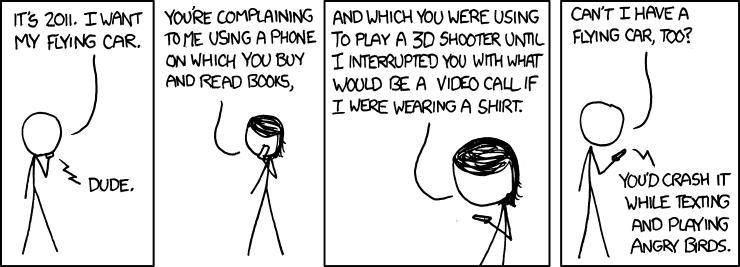
Some light relief from flying cars:
Permanent link to this comic: http://xkcd.com/864/

recapping the phd process

What i began with and where i have gotten to are different spaces.
I shouldnt be surprized, but the 'argument of a thesis' seems to suggest one starts here (problem) and gets here (recommendations).

And mine didnt do this.
Im studying change and what i notice is it only ever looks like a clean trajectory retrospectively.

What i began with was how to teach issues of heart and soul using IT.
By the time i got to colloquium I was advised just one of these would be enough, and by the time i had got to ethics application it had morphed and mushroom clouded into three separate studies, comparing professional with lay studies of how care is communicated through IT applications.

Getting real following this attempt to fly too close to the sun, and the process of writing the multiple ethics applications, had me falling out of the sky as my wings melted...

So after a serious and somewhat long talk with my very generous supervisor, i came down to earth; just one of these studies was enough. I remember we talked of which one would go the distance, would be 'sexy', would be the cure for cancer...

So i have an umbrella of studying change, and inside of this the use of emergent technologies in a community helpline, and this has of itself narrowed itself down to what evolved as most popular by the users of the service, being txt messaging for counselling.

Studying change as it occurs is like studying the blur...

I am now close to finishing...but have been at this stage for a year..i am rewriting the front end...and rewriting the back end...and rewriting.
My metaphor for this stage is a flatpack bicycle where every time i get the front end right, the back end no longer aligns and vice versa...but its getting closer, i think its beginning to look like if i 'rode it' it would no longer fall apart, the speed wobbles are less severe.

Interesting some of my most useful reading is what i have read after data is collected- reading i didnt even recognize as useful until i hit the wall, and then on rereading it made sense- and reading that i couldnt make sense of 5 years ago which is now comprehendable- and readings i didnt know i would need until the data analysis led me there- and some reading that wasnt even written when i began :)

And in writing when i hit a blind spot, sudden surprizes that blind me, i rewrite earlier bits while i let the current dazzle settle... had yet another fret about how to write of the research process and the sensitive ethics ...
The bits that are fast to write and the bits that are slow are utterly unpredictable.

Tuesday, February 22, 2011

Texting comes of age

Today the NZ Government is asking that people use text messaging instead of phoning loved ones in Christchurch.
(This is following a second significant earthquake in CHCH)
Seems SMS has reached a level of respectability, and is a preferred choice in emergencies.

Information from telecom:
The Christchurch 111 call centre has been successfully diverted to Wellington, and a back up site in Palmerston North is on standby if required. Issues connecting will be due to network damage, congestion or power-related issues.

Thursday, February 10, 2011

For Tom


Pilgrim Library Stained Glass, originally uploaded by Andrew|W.

What sunshine couldnt do without stained glass, nor stained glass without the light...
Living in a connected world matters, but i thinks its how we are shaped in connections that matters more.
A combination effect of relationality. Who I am and how I think, and what i learn is held in the network. The one does not happen without the other.
Such knowledge gained has this ephemeral quality, its held in the network; and does not hold the same shape when attempts are made to move it from here to there, such movement cannot help but shift it further.

On being in the prisms of possibility: from Thomas, a letter in reply

Reply
profesorbaker says:
February 9, 2011 at 1:18 pm

Hi Elise,

You are here with me today, as I was with you the past day, reading your writing.

Ailsa, you must know, that if I knew you, I would insist on calling you “Elise”, for that is the moment when your writing spoke to me, when your lovely voice first rose from the shadows of print surrounding it, and gave me the possibility of understanding what CCK11 means to me personally, when I first called you, “Elise”.

After reading your writing, I listened to this lovely pianist, playing your song, written centuries ago, and named, for you, “Für Elise”, “For Ailsa”, by Beethoven himself.

Yes, too much optimism, on anyone’s part, is a clear and present danger. On the other hand, a lack of optimism, a failure to believe that you can calm the wind, that you can sustain yourself over water, is also, a clear and present danger.

Only those crazy souls, who dare to dream that a man can fly, only those souls who see life not within the prism of its apparent limitations, but within the prism of its possibility, its potential, its “this-is-something-I-would-like-to-do-ness, and “why hasn’t someone done this before”, those are the ones who push the human race forward, I’ve been told.

Elise, we both agree on one thing, that life is beautiful, although scary at times, and if we strive for the beauty, I’m sure there will be music for us, even if we “be the only ones listening”, to Beethoven himself, playing your song, “Für Elise”…

Oh, Ailsa, your thesis is surely a majestic melody, and your smile, if it be like my smile, must surely last for a while….

My best regards, for my friend, Elise/Ailsa

Thomas

And: A letter to Thomas from Elise

Do you recall a letter written to Carl Rogers by Rollo May? It too asked that we consider relationality, for optimism alone may not be enough.

May, R. (1982). The problem of evil: An open letter to Carl Rogers. Journal of Humanistic Psychology, 22(10), 10-21. doi:10.1177/0022167882223003

Sometimes i get a little scared by too much positivity, a tyranny of niceness, a faith in connecting that assumes inherent goodness, and/or an evangelical regard for the wonders of machines that go ping.

Your post is very beautiful, eloquent and provocative…it has made me rewrite a part of my thesis writing, and has left me smiling most of the evening…it is also one of the most beautiful pieces of music ever made.
so i thank you, sincerely, ailsa

On: A letter to Elise

Ive kept a copy of our exchanges, and in trust i hope Tom does not mind.
But ive found before that a digital world is sometimes ephemeral, sometimes links no longer take me back to where i want to be, so this is a copy of an exchange held in the public spaces of our blogs.
I'd wrap them with a blue satin ribbon if i could, and place then somewhere precious for safe keeping, but the digital makes some things more and less possible.
Thomas' letter to Elise that followed my previous blog, on where the wild things are:

Hi Elise,

I liked a lot of things in your lovely post. I am a great one for “voice” and I listened to the “voice” present in this post of yours.

You (like me also) have looked at the criticism and controversy surrounding Connectivism as a theory of learning. Rather than turn to criticism, you turned to critique, doing the research required to present your points, well-supported, deliciously, eloquently offered to the reader, in this instance, myself.

Oh, the reading of your post was beautiful, and a measured voice, a reasoned voice, a wise voice emerged, to calm the wind, to view the water’s potential to hold us, if we but dare to walk upon it….

My point: Connectivism, as a Theory of Learning for a Digital Age, is not perfect, but perfectible.

In the meanwhile, a calm voice is appreciated, especially for those who defend the status quo, perhaps secretly fearing possible displacement by a digital age which is now demanding it’s own theory of learning.


No, I have erred. The digital age isn’t demanding anything. Real people are. “Who are these real people?”, you ask.

Digital learners. Digital learners, born in a digital age, the children of the digital age, the children of today, who will have to solve the world problems that you and I are leaving them as their lasting inheritance from us.

You see, you and I didn’t solve the problem of world hunger. As we sat at our tables yesterday, there were others who went to bed hungry.

You see, you and I didn’t solve the problem of world peace. As we watched the news on TV last night, maybe enjoying a pizza delivered by the home delivery service, there were people killing, and being killed, somewhere on this planet.

You see, you and I didn’t solve the problem of poverty. The children of the digital age have to live in a world where 1% of the world’s population has 80% of the world’s wealth.

Our digital children are a part of the 99% that’s fighting for a share of the 20% that’s left.

You see, you and I didn’t solve the problem of global warming.

While we talked about the appalling lack of scientific evidence to support such a claim, how Al Gore couldn’t be trusted, how the snow on Mt. Kilamanjaro disappeared in 2000 and came back in 2008 and disappeared again, how severe summers became the global norm, how wild whirlwinds whirled with regularity, and how the very Earth itself quaked incessantly in 2010, our weather and our planet simply became a bit more inhospitable for life itself, human life that is…

These are only a few of the problems we know we are leaving to the children of the digital age to solve. Their brilliance gives us reason to hope, to be optimistic about the future. But here’s the rub: what about those problems that we’re leaving the children of the digital age to solve, that we don’t know we are leaving to be solved?

You know, those problems that no one sees coming, the problems no one has thought about, no one has ever imagined? Will the education of the past century be up to that kind of task?

Listen to the digital age, for it speaks to us:

The digital age cries out: “Look at me! Look at my new clothes! Am I not more beautiful? Look at all my brilliant connections who share knowledge with me now!”

And we, the children of the last century, the vox populi, we too cry out: “We liked you the way you were dressed last year, ten years ago, last century! Was it not enough for you that I, and I alone, your teacher, poured my knowledge from my brain into yours?


Connections? Bah, humbug!

Who needs connections when you have me? Take those new clothes off! Come into my classroom, turn off that cellphone, put away your digital toys, turn off that blasted computer, no YouTube, no Skype, no instant messaging, no social media for you. By Jove, this is a classroom! We are doing education in here! Get in your seat, second row, third desk, behind student number 33.”

Teacher (smiling) “Good morning class. Today I will be telling you all about…”

Connectivism: A Theory of Learning for a Digital Age, is playing catch-up to Connectivism: the Practice of Learning in a Digital Age.

The transformation, the paradigm shift, the revolution, the reformation, call it what you will, but it has already happened.

We are not Einstein, we are not Newton, we are not the makers of the wheel.

No, we are simply describing the wheel: It’s round and it makes getting from Point A to Point B a heck of a lot more enjoyable.

We’ve already been hit on the head by the apple, gravity has happened, and now we explain why that apple fell down, on our heads, rather than rise into the sky…

E = MC squared? Now that was a tough sell, wasn’t it? But if Einstein could do it, working alone in a patent office, a-l-o-n-e, connected to no one but himself, then what do you think Mankind, the children of the digital age, will do, when they connect and share their knowledge?

Oh, I would think that they will solve problems that we children of the past century could not, or would not, solve…

Best regards,
Thomas