Showing posts with label text messaging. Show all posts

Thursday, February 24, 2011

Text messaging comes of age in a disaster

When I started my phd text messaging was seen as a trivial application, as was also the situation for twitter and for facebook, but as is shown in the New Zealand Christchurch earthquake disaster, these platforms have been invaluable.

Text messaging factoids: a cell phone tower covers a small distance. Most have little power and so cant reach far. In NZ most cell phone towers are not shared by the different telecos, but with threats of deregulation telecom had to share parts of the main network.
Also the towers when they are not plugged into main source power have temporary generators that last approximately 10 hours, and then will only function if the power is back on or connected to a generator.

What this means on a practical level: any one cell phone tower can only take about 60 calls at any one time. SMS is so much smaller so is more likely to get through.(This is now being recommended by the PM and civil defence and telecos during the Chch earthquake emergency) Also if the towers get busy, an sms bounces around till it finds a gap. A call cant do this, so just gets a busy signal. Sending pics and videos similarly take up more space, so can clog the towers when there are emergencies. (And so telecos are requesting people dont do this during the Chch earthquake emergency)

A further interesting telephone related fact that comes to light in the Chch earthquake disaster, cordless phones in people's homes require electricity to work. Donations of analogue, corded phones are being called for. This type of phone can work where electricity is still not operating.


Other social networking that has evolved;
Twitter and hash keys #nzeq, #chch to follow real time news
Use of trademe, to advertise free accommadation and labour:
http://www.trademe.co.nz/Chch-earthquake-support/Volunteer-labour/mcat-9530-9532-.htm
Google freely provided a person locator really early on http://christchurch-2011.person-finder.appspot.com/
Telecom making public phones in chch free
AirNZ cheap flights in and out of chch,
Distribution of solar charges for cell phones...
Facebook for accommodation relocation
Studentarmy, Thousands doing the suburban clean up, and
Telecom and vodafone are working together
(eg Vodafone New Zealand asking people to Donate corded analogue landlines to CHCH at any @telecomnz stores)
Help from the world has been amazing

Thankyou world.

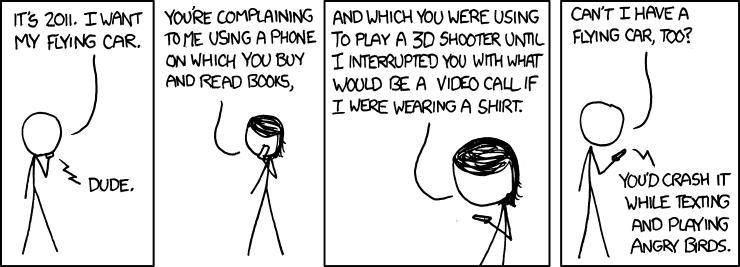
Some light relief from flying cars:
Permanent link to this comic: http://xkcd.com/864/

Thursday, April 22, 2010

The cost of texting

What price do you put on having people who love you as close as your pocket, anywhere, anytime?
Given such measures are hard to calculate, what is the 'true' or financial cost of a text message?
Please do check the maths, the dashboard isnt up with the digital play, and maths is not my strong point...however the bit calculator has helped

A standard SMS message contains up to a maximum of 160 characters.
Most messages are way shorter than this,but I will work with the standard charge as people are charged for the potential not what is actual.

Apparently SMS uses 7 - not 8 - bit characters - and it is 1 bit to 8 bytes, except when its SMS and then its 7 normally...
1120bits divided by 7 gives the 160 characters that can be used in a message

At the maximum, of 160 characters, that would be a transfer of 1120 bits of data and converting this to Bytes...
140 bytes

And using my online converter this is
0.13671875 Kb

The costing in NZ has been 20 cents a message sent, regardless of whether it is one character at 7 bits or 160 characters at 1120 bits.
Admittedly there are a variety of other costing options now available (2010)
with telecom
and vodafone
and 2degree mobile (newcomer with a significantly lowered transaction cost, not used by the majority of cell phone users so i have not yet factored these costs)

And regardless of the number of bits sent, we are charged at the maximum possible, used or not, 140 bytes of message being sent each time.

So, 140 bytes divided by the cost per message gives us 140/20 so,
every 7 bytes of data sent by mobile SMS costs a NZ 0.01 cent.

I'm told by the people I interview for my PhD research that young people use texting because it's cheap, but I am now wondering if the actual costs are cheap.
How does texting compare then with other media transfer costs?

The cost of a song to my ipod...
2500Kb to 6000Kb per song and a song would cost me 99cents per song from apple.
If I take nice little songs with nice round numbers, say 4MB or 4000Kb or 40,000 bytes of data. Then that song is going to cost me- from apple-
40,000/99=404
404 bytes of data costs a NZ 0.01 cent.

And then to download it on my NZ$67.00 a month plan for 10 gigabytes
(10 gigabytes is 10485760 Kb or 10737418240 bytes or 85899345920 bits)
(Nb. this also gives me a web page posting, but note how expensive broadband access is for NZers...yet it is soooo much cheaper than sending a text message)

10737418240 bytes can be be divided by my monthly broadband charge of $67.00
to work out the NZ$1.00 charge per byte, so,
160259974 bytes per NZ$1.00
and divided by 100 cents in the dollar, gives me
1602599.74 bytes to the NZ 0.01 cent.

Now I'm not a maths savvy person, so feel free to correct this if I am wrong

for 1 cent 'apple' can sell me 404 bytes of access to a song
for 1 cent I get 1602599.74 bytes of data downloaded when I'm on my computer
and 1 cent gets me 7 bytes when I am sending a cell phone message
Wow.
23,000 times more expensive to text on a mobile phone than data transfer by computer

It is more than a little unfair to compare 'apples with oranges' as I don't have any 'need' for a song, but I might have 'need' for contact.

So comparing texting with other forms of communication:

A letter. How much does that cost me?
NZ $0.50c, for 500gms standard post.
This would be unfair, taking three days to arrive isn't really a fair contrast.
Within 24 hours fast post, NZ$1.00 per 500gm.
A more reasonable contrast, however, I do note that convenience is compromised, but maybe being able to say so much and even send pictures could be used to balance the equation a little.
A sheet of paper weighs about 4.5 grams...and I need to allow for an envelope...so I could easily send 100 pages...and I can write, or draw, on both sides!
When I'm teaching students essay writing, I assume a rough count of 250 words a page...average word is 5 characters, add one character for space per word...and font size still has to be reasonable...and I can send 250 words per page x2 as its double sided...
So that is 500 words a page x 100 pages
50,000 words for NZ $1.00
Or 500 words per cent (not that this is possible, because i will be charged the minimum NZ$1.00 postage)

And 500 words per page (double sided) times 6 (average letters per word and a gap per word), times 100 for the number of pages I can send plus the weight of an envelope...
Then 500x6x100 = 300,000 bits can be sent
And if I take the 'bit' charge per character as 7, since that is what SMS messaging works on... then
300,000 bits could be sent for NZ$1.00
30,000 bits for NZ 0.01 cent.

To convert bits to bytes...
1024 bits to the byte...1 bit = 8 bytes usually -except in the case of text its 7 -
1 bit 7 bytes
30,000 bits x 7 = 3750 bytes or 3.662109375 Kb

Bear in mind, I should subtract the costs of these pieces of paper, and of the ink, but at present i will stick with the transaction cost...


so 1 cent to apple can sell me 404 bytes of access to a song for as long as i want it
for 1 cent I get 14925 bytes of data downloaded when I'm on my computer
and 1 cent gets me 3750 bytes of mail delivery
and 1 cent gets me 7 bytes when I am sending a cell phone message

Amazing then that texting is bought as a cheap option...
"fast, (almost) free, and easy"
'Cheapness' is a relative concept, it is what's perceived.
It also involves issues of convenience, and of relative comparisons.
Being able to 'do it' and 'do it now' has enormous appeal.
The costs of a phone call are higher. The start up costs for a computer vs mobile are higher. The monthly cost with a server is higher- albeit that it gives me greater service potential. The time and transaction needed for sending a letter is longer and more convoluted.
My mobile is as close as my pocket, but I am paying significantly for convenience.

This blog was prompted by today's sideswipe article
True cost of texting:

"According to Nigel Bannister, a scientist at the University of Leicester, sending a text message can be up to four times more expensive than downloading the same amount of data from the Hubble Space Telescope."

Which traces back to a 2008 article http://www.physorg.com/news129793047.html

Saturday, March 21, 2009

Giving up texting for Lent

The devil comes in many forms apparently and texting supposedly is one of them.
Cited/sighted within "to text is to sin":

Only a few months ago the Pope was using his channel on YouTube to warn against our "obsessive" use of mobile phones and the net.
This week came the news that senior Italian Catholic clerics are urging their flocks to give up texting, Facebook and Twitter for Lent.
Renouncing texting would enable young people to "detox from the virtual world and get back in touch with themselves."

Now there's several thoughts here worth exploring.
Getting in touch with oneself...mmmm...am blinded by that one 8)
Getting real...detoxing from the virtual...mmmm...
Heaven, will just have to wait.

Wednesday, December 05, 2007

the strength of weak ties

"Strength does not come from concentration, purity and unity, but
from dissemination, heterogeneity and the careful plaiting of weak ties."
(Latour, 1997).
Plaiting the weak ties is the metaphor used in making a more durable entity: "...resistance, obduracy and sturdiness is more easily achieved through netting, lacing, weaving, twisting, of ties that are weak by themselves, and that each tie, no matter how strong, is itself woven out of still weaker threads..."
In applications of communications and computer technologies for counselling, there appears to be some strengthening of the weak ties; another actor is enrolled. Lifeline has launched txt messaging, and using an Internet based website for postings through a web page targeting young people with depression. This seems to add a little more substance to a 'novel' practice, the larger and arguably more conservative organisation seems to add a veneer of respectability to a method of counselling considered suspect by others.
I really want to follow this lead... it is a new endeavour for lifeline, being launched 3/12/07. Youthline's text service began December 2004 and Internet postings much earlier with the launch of the Urge website. One aspect argued by the CEO OF Youthline in an October 2007 press release was about not reinventing the texting wheel. The competitive funding model to my mind, continues to put services up against each other. The potential is that threads unravel.

A further musing installment on the question: what is occurring as counselors (re)shape their practice; and what is practice doing back?

Monday, December 03, 2007

Beam me up Scotty


I am just waiting for the newspaper competition of fill in the thought bubble: Tell me again why I should spend less time with the people I love and more time with strangers?
etiquette involved in martyrdom and suffering seems superfluous to many. The use of phone booths could be subject to an ant informed analysis, predating Dr Who and the TARDIS, the need to have a booth compensated for the vulnerability of the technology and the quality of the connection. Arguably such factors helped to create the expectation that calls occur privately. Current advances in audibility and portability may be aiding and abetting the publicly displayed intimacies that others find surprizing if not offensive.

Saturday, December 01, 2007

Ubiquitous cell phone as common as muck

The worlds population reached 6,634,294,193 yesterday (at least according to International Programs Center of the US Census Bureau)
And cell phone subscriptions reached half this number...
Perhaps minus one
Please note, saturation of the worlds population with cell phones is not 50%; many of us have more cell phones than we know what to do with!
I confess to having more cell phones in my family than people (its useful to have a spare for people from o/s, or for when one goes down, gets washed, dies (cell phone I meant).
My last poll in a large lecture class showed all but one student had a cell phone, many had more than one, several confessed to living in households where the numbers were in excess of the people. I am not alone.
NZ Prime Minister Helen Clarke confessed she has 3, and arguably has found texting a useful diversion during Monarchy and Heads of State addresses. Nice to know she is multi-talented, and up with the play. I like this in a PM.
I can wonder if she was receiving the aussie updates on polling or playing that cute duck game with the traintrack you have to construct...
I like problem solving if not hand eye coordination in a PM too.
Sadly she cant remember; this is a less positive attribute in a PM :(
I wonder when she's going to get her own Bebo page so i can add her to my list of friends :)

On a more serious note, the use of cell phones is fast becoming a very normal practice. The rate of change as people debate the etiquette, the good, the bad, demonstrates how change is negotiated.
My description of cell phone use for counselling seemed to cause consternation amongst the group of psychotherapists I conversed with at a recent social event. Shock horror, I still have social outings... but there seemed to be furtive glancing about, as if a sudden need for crosses, holy water, garlic or stakes. I went looking for the chardonnay.
After all i might need a glass to put out my smoking paw...

Saturday, November 24, 2007

help, not waving, drowning: Discourse analysis of SMS

I am not strong on discourse analysis.
I spent one summer trying to read Foucault and this convinced me two summers doing this would be unwise.
Please help. seriously.
This is not my intended methodology, but it may prove useful. If you are experienced in discourse or even curious regarding the application to an intriguing application, please play with me here. Beginning with a toe in the water rather than full immersion because i don't like drowning, here is my tentative discourse analysis of a series of txt messages in counselling. (Feel free to push me in deeper if needed, or tell me to get out of the water....)
This series of interactions are from one side of a txting counselling scenario.
(The stream of txt was never seen, it is based in reality rather than actual reflection of reality. To do any type of data collection wherein one does not have the consent of the authors of the text is not ethically defensible. To do discourse analysis on a reported composite of a text is also methodologically dubious. This is a work of fiction).

1. "I just want to disappear"
2. "I cant talk"
3. "what diff email"
4. "r you a counsellor"

Discourse analysis
line 1, an opening, a cry for help, a reaching out.
Txted to a 'netherworld" an unknown entity. The txter doesnt know the person who will receive it, Maybe the anonymity helps. A confirmation of no one responding might confirm the sense of disappearing. There seems an ambivalence, will i disappear, am i disappearing, do people notice me. There is also an 'i want to' do i hurt so much i just want to vanish, i just want it to end?
(Did you notice that, I switched from 3rd person to first, not only do i project in, i begin to imagine myself in...)

line 2, a response to an invitation to talk further. The counsellor has responded (affirming the person for making contact, acknowledging their distress or difficulty, and inviting the person to use a ph line to talk about it). Line 2 rejects using a phone. "I cant" without punctuation. Punctuation is extra difficult on a cell. Plus it may or may not be known by the sender. Or may not be important to the sender, it takes extra time and it doesn't significantly alter the message. But the message in its brevity remains ambiguous. I cant talk because its too distressing (I cant talk because I have no money on my phone? I cant talk because others will hear? ...)
The use of capitals for I, is probably auto generated on the cell phone.

line 3, responding to the counsellor suggesting other options, seeking clarification on those options. The txt is truncated, a word is shortened and syntax condensed presenting an incomplete sentence. The meaning is sufficiently clear regarding a clarification request. There is another quality though, the person sending the message is engaged in concrete specific concerns. The concern though becomes about the equipment, how do i , rather than this is what i am distressed about. My sense is not that there is no difference in that 'i' cant talk regardless of the medium. But a seeking of clarification, i may not want to verbalise it because its distressing. 'i' might be able to enter into an email dialogue if 'i' can see a reason.

line 4, in the invisible space of txting whose on the other end seems to need checking, asking. Just as with internet cartoon where noone knows your a dog, in txting too no one knows whose there. sex is indeterminate, age is indeterminate, role is indeterminate. If I can enter into conversation via txt with you, is it because you are a counsellor and this seems ok so far and i might generalise from this counsellors therefore seem safe. Or is it a question of if i take the next step will i see you. Interesting some words truncate some dont. The use of the cell phone and the ease of some words versus others?

Please, I am really happy to receive input on this naive analysis and will now go (internet) surfing to reduce my naivity.

Other theory relevant:
Sproull and Kiesler (1991) regarding emails say "people talk with other people but they do so alone". This too explains the need for checking out who is the person at the end of the txt receiving "my' message. In addition,they write of the conventions for communicating being weak - This may be reflected in the question of are you a counsellor- who are you, what are you, as well as other conventions of social practices such as grammar being weaker.
Constance, Sproull and Kiesler (1996) Reflect on the kindness of strangers and the strength of weak ties.
Turkle (I think, but i cant find this so maybe it is more Sproull and Kiesler) talk of the projection onto messages. In the absence of more cues- tone, body language and the amount of information exchanged, there is a tendency to read more into a message- project more onto the message- than is actually there.
Bloch (2002) said email is used for creating and sustaining relationships. and also
showed email not just about language but is also about negotiating identity in a way not done in a classroom. Suggests in a counseling scenario there is also the use for negotiating identity, who am I, who are you, can we work together.
Rich Ling, Telenor R&D (2005) on discourse analysis of sms in Norway: note that its cheap, relatively unobtrusive (can be done silently), they describe sms as an "odd duck": the size of the screen limits readability, the 160 character limitation of screen, the lack of traditional of keyboard. They also discuss the differences Male to Female with female being more attentive to emotion, to flourishes of writing (punctuation), longer messages male average 5.54 vs female average 6.94, females also use more salutations. I wonder if use by women is greater as women, at least stereotypically maintain connection, relationships. Its also cheaper to sms than a ph call, and maybe women have less discretionary income. These writers also identify the liklihood of first letter capitalisation because of a default mechanism.