Wednesday, April 20, 2011

phd procatsination: lolcat tells it like it iz

Here is my lolcat thesis conclusion

And here's the story of my progress on the thesis, though the lolcats here are not my own, my story resonates with what is told in these pictures.
I am all over the place but dont know it
The topic is teaching issues of heart and soul using IT (information technologies)
And Im searching for a place to hang it,
I settle on a uni, one outside of NZ, write a proposal, thats all over the place, huge, but enthusiastic.
I get a supervisor appointed and we establish some shared interests , we both like Macs, we both read some of the same people, we both know some of the same people (NZers are known for only having 2-3 degrees of separation)
I read for a year. I get used to endnote. It does not get used to me.
I get familiar with technology. Some of it gets familiar right back. (i find i get adverts tailor made to my searchings...i get stalked by cyberbots and cheap marketeers on my blog...and just now there's an option for turning the blog into a book...dont think the coherence would stack up for the markers, but its a thought...)

I'm on bebo, facebook, twitter...
I write a plan, annually i repeat this step in creative writing, I tell myself it doesnt matter, its a fiction. Ignore the timelines, but oddly, retrospectively, and with no intention at all, I see they are actually reasonably accurate.
I write a colloquium document,20,000 words.
I write through writers blocks about whats blocking me establishing the need for the research, scoping relevant literature and a research method and demonstrate knowledge of the ethics involved. I have tentatively approached one of the three places i wish to undertake the research. I want to compare and contrast them.
At my verbal colloquium (two profs, two academics,three internal to the uni one external) it is put to me that it is to big. I argue it is the contrast Im interested in, they suggest again we might rework this as i progress.
I keep reading, I attempt the multiple ethics applications, multi layered,internationally, and come to a grinding halt. Its too big. argggghhhh
My supervisor talks me through options, i dont see the wood for the trees. I'm so glad he can. I recall a conversation about which of these is the 'cure for cancer' and where do i want to be positioned into the future.
I make a choice to study change and a voluntary organisations use of emergent technologies.
Knocking it back to one site of study i do an ethics application that is still huge, still multi layered but only involves one site. Phew. And then i do it again for a NZ ethics committee. Its huge, its persoanl, private, involves children, involves children without parental permission, it involves artefacts where consent was not explicitly sought. Only alarm bells not hit are working with human remains, radioactivity or genetic modification.
All this fussing over...text messaging...

Bilingual thesis?
I read and read and write and write and data collect, exciting times, intellectually.
Socially i suspect i become more of a one track conversationalist. I'm glad i have friends similarly narrow minded. We take turns in talking our narrow fields.
And here's where i stay for a long time, there's a lot to read, a lot to write, and im waiting on getting a 360 ish data collect with particularly ethereal research participants to come forward. They eventually do.
Meantime I now have a multi levelled tangled mountain of threads of data to work out what to do...
Tangled mess of data.

I tease out threads, I read, i tease out threads and read and write, and find some ways through and into to sort this knotted mess of tangled thoughts and observations and everything.
Putting the world into words is not easy. I blog bits of this.
I write of some of the threads followed, and i find literature that similarly writes of such messes.
I have lost my soul to this tangle

The writing progresses. I have an intro. I have a perfunctory and boring lit review.
I have a research method. I have data. I come back to the boring lit. I rewrite and rewrite. I eventually find an article that helps rewrite this so i hate it less. I do wish that writer had written that article earlier, but if he had i suspect i still would not have recognized its value... the rewriting puts a new spin on the latter stuff, i rewrite the latter stuff... finally the process feels iterative. Ive heard its meant to be and am now feeling a bit more confident that I'm doing something that works, something others describe as normal.
Im less pushed around by what i fall over, Im less reactive to whats possible.
I have more control on my world.

I have a clearing sense of what it is thats new, of what i did and why, of how i did it and can justify this. I wish these writers i love would stop writing, i havent yet got to the top of the literature mountain and there is stuff i would like to read more slowly, stuff i would like to read again. But i need to write, there is a timeline.
I am becoming discriminatory in what i have time for and what id do not. I thought i had this before, but now its much more decisive.Im getting a bit OCD, But Ive got it sorted.

I write too much, There is a word limit and i can see i am going to go over it. I work at killing my darlings,
the words so carefully crafted. Iteratively i recheck whats before so that whats left out no longer matters. There is a blurring. the document writhes as i try to recall whats in whats out, i know ive written stuff but where...i try to keep an unruly pack of cards stacked and fantasize handing in a snowglobe of paper where order doesnt matter.
But then i realize its just about folding the world differently.

World making is what it is.
I keep writing.
I have about a tenth more of methodology to do, about a tenth more of data to be played with
And then conclusions, about three i think, short snappy one...reality i have learned is multiple, and so for my endings.
Meantime i am more sedentry than ever, the brain is active, its had a major workout, so has the soul, meaning of life... the body not so much...


An exercise in worldmaking :)

Sunday, April 10, 2011

A thesis in almost plain language

Attempting a plain language summary of my study as suggested in phdchat# and role modelled by @lizith, @OrgMotivation, @martin_eve and @jennacondie,and @claretCarly

Its an interesting assignment, one i have turned to my own ends. Since I am studying the use of change with emergent technologies in a youth counselling centre, and since young people appear to be changing this service from the outside in by using text (SMS) messaging as their preferred means of making contact with the organization, I provide a summary of my thesis in txt spk.


when kidz txt a helpline
wats goin on?
who & wats involvd?
wuld u? culd u? shuld u?
dunno?
This thesis looks @ changes @
Youthline NZ: a crisis helpline
4 young peeps


Now for the less succinct version, where i try to be clear, but its not quite plain, I'm still attached to certain turns of phrase.
Change and the use of emergent technologies in a NZ youth counselling centre


This research focuses on the relationship between how people think about change and what they do to enact it. This is explored with reference to changing health professional practices where interpersonal interactions are increasingly mediated through computer and communication technologies. In investigating the use of new and emergent technologies for counselling the study traces how the work of counselling is reconfigured, and how relationships of those involved are negotiated.

The site of study is a not-for-profit organisation, Youthline (Auckland, NZ). When this study begins the organization is providing telephone counselling predominantly through its crisis helpline. At the start of this study there is a constant buzz of phones ringing and of counselling conversations occurring. Over the course of this study the phone rooms become almost silent. Youth still have problems, and still seek help, but increasingly this occurs silently. This study investigates what occurs as counselling moves into the silent and small space of short message service (SMS) or text-based mobile phones.

In providing a text-based helpline since December 2004, this organisation becomes a world leader in the practice. There is presently no evidence base for this practice and while this study does not address the effectiveness of such interventions, it does consider factors making the practice more, and less, viable.

The analysis is undertaken within an actor-network sensibility. Actor-network theory (ANT) emphasizes relationships held, dissolving and evolving between actors whether human or otherwise. This study investigates how the actors involved, human and otherwise, are performed in, by, and through their relationships.

Performances of change and the use of text-based counselling are presented as short narratives, slices of practice, telling of contingent relationships. Eliciting these narratives included interviews, artefact analysis and observations of practice, over the course of two years.

The performance of such stories provides partial and decentred ways of knowing. The use of the word partial is deliberate and relates to more than one meaning. The stories do not, and cannot, encompass the whole. In addition, such stories reflect the author’s own partiality. “I” write a text composed of slices, where such slices of stories sometimes sit alongside one another, but which more often intersect and which sometimes clash, reflecting the precarious reality this thesis depicts.

A tangle of constitutive relationships are shown to embed mobile phone use and texting in particular, in young people's daily lives. In analysing the tangle of contingent relations making text counselling more and less viable, the intent was never to prove text counselling as good or bad, but to know the uncertain and revisable nature of text counselling as practiced. Opening up text counselling allows us to see how this practice is shaped and might be shaped otherwise. Specific strategies for strengthening the work of this not-for-profit organisation are then able to be made explicit.


I really would appreciate some feedback on this:
1. Should the txt spk version be the first page of my thesis?
2. Is the longer version clear?
3. Any other feedback also welcomed :)

Sunday, April 03, 2011

Actor-Networking / Artist Networking


I became interested in this art as a result of two presentations given by Bruno Latour, where one of his ppt slides used the artists work. Annoyingly these videos that i had previously linked to, and which ANTHEM had linked to are no longer on the server.One is still accessible here: is http://www.aaschool.ac.uk//VIDEO/lecture.php?ID=1380

What is also odd is the difficulty i have in tracing how i got to this artist Saraceno this morning, i cant recall the trace of how i got to it, searching my history in firefox doesnt do it. I am left with holes as big as those in the imagery: the gaps in the digital trace of my net surfing as well as wondering how can i be so forgetful when I'm only talking about half an hour.
Odd how ethereal such traces can be.


The artist is Tomas Saraceno. Images on a google search are here


Now to network in my computer clever one to rip it...

Saturday, April 02, 2011

A thesis txt spk: 2b/not 2b?

I'm finding voice, and negotiating whose voices gets heard in the thesis.
Mine own being one part of this.
Since a major component of my thesis has been the take over of a youth counselling network by text, culd i jus txt?

Seth Godin states

"My take: the smaller the screen, the more hurried and less informed the decision ends up being.

Yes, there's more currency, more immediacy, more with-you-right-now-all-the-time and more data being collected. But......

If you're working with a spreadsheet or a thread of correspondence or a set of data, I'm not sure you're doing your best work if you're doing it on an iPhone."

Seth

Guess that's why the phd wont be submitted in txt spk


Nonetheless,
the writing off a medium as less useful for good works is a bit offhand.
And Godin uses twitter himself to point to very short blog postings.
The good works still occur.

But what is useful here is that he has identified consideration for what suits from what does not.
Some digital literacy is called for in such choices.
Lankshear and Knowbel, challenge understandings of literacy and of digital literacy especially:
texts evoke interpretation on all kinds of levels that may only partially be ‘tappable’or ‘accessible’ linguistically...The significance of the new technical stuff largely has to do with how it enables people to build and participate in literacy practices that involve different kinds of values.

An appreciation then of media effects, in what ways are values reshaped?
Leads me to consider questions of power and influence, and to know how technology has influence.

Or to use Kevin Kelly's phrases, its about having consideration for what technology wants.
And then negotiating this.

A first step would be to increase awareness of what technology asks people to do; so I have listened for it. And being informed by Bruno Latour's Actor-network approach, I interview the technologies involved: Have them submit their cvs, ask them about their best practice, do some performance based questioning, and some performance review in observing practice

And following wot apears to b a hostile tkeova,

The thesis i am negotiating wnt b
txt spk

wuld b 2 tight & probly trite

:-#

2L8

Friday, March 18, 2011

Storytelling: writing a thesis


Once upon a time is a much more interesting narrative than thesis writing, where typically the format follows: this is the problem, this is how it is addressed, and here's what was found, and therefore this is recommended.
As an example:
This study into what went wrong found little red riding hood set up by her mother, duped by a wolf, saved by the woodchopper, and at the end the wolf is dead, but so is her grandmother....but lets not dwell on the negative. Although we may also have some recommendations about childcare that could be the subject of another thesis.

*sigh* The only reason that would work as a bedtime story is because it would induce sleep.

The absence of thrill in academic writing is the subject of a blogpostand a twitter link by @andycoverdale who cites Jonathon Wolff's article titled Literary boredom
Rather than fostering excitement, academic writing styles give the plot away on page 1.
A peculiar attribute for avid readers, is it that academics have to read so much they need the last page first?

Could a more engaging narrative be written as a thesis?
This could be serious, if its to change something, and don't all thesis writers set out to make a difference, then it cant do that if no-one reads it.

Option 2, turn it into something more thrilling in your post-doc life.

In considering the story rather than the plot... it is possible for a thesis to engage otherwise, it does not have to be situated in a netherworld of absent authors and distanced readers, cancelling the distance between reader writer and subject matter is what Patti Lather writes of in academic speak.

In their 2004 book, Storytelling in Organizations, John Seely Brown, Stephen Denning, Katalina Groh and Laurence Prusak explore how narrative can be used for transferring knowledge, nurturing community, stimulating innovation and preserving values. These are things I want my thesis to do. Surely it is possible to get there without being dull?

For Latour also, it is in the story telling that uncertainty resides. If the story doesnt engage, an ANT analysis fails.

But if a thesis doesnt follow conventional wisdom, might it fail also?
A point of tension: do I take the risky exciting path that might have wolves?
Or the path where the wolves are dealt to in advance?
The latter is obviously the safer option, these academic types dont seem to want surprizes...we save those for our children, ironically to help them sleep at night.
How strange is that?

"This dark telling is of a young girl with a mother whose stretched too thin, sandwiched between providing care of children, care of aging parents, and wriitng a thesis,but soon the daughter finds she has far more important things to worry about than lack of dinners on the table and having to take sandwiches to her granny. When people start turning up dead with their throats ripped out, she begins to suspect her Granny may be to blame."

Now to write my own thesis review: A great story bought back to life by interruptions to the thesis narrative.

This leaves openings for further study, perhaps a gendered telling...where's the father in all of this?
Or a feminist marxist one...exploitation and inequality in the divisions of labour
Perhaps an empowerment narrative might leave less bitterness? But heh, just whose reality do we work with here? This is not a happy telling for any of those involved, wolves have to live and eat too, and are probably an endangered species, the mother's worn out, the young and old neglected, and the woodchopper- please tell me he doesnt get to carry off the child or Im going to have to get concerned about further dubious and exploitive relationships...

Perhaps, having written out my angst I should now return to the endeavour of writing for the staid audience of thesis markers.

References
Lather, P. (1997). Creating a multilayered text: Women, AIDS, and Angels. In W. G. Tierney & Y. S. Lincoln (Eds.), Representation and the text: re-framing the narrative voice (pp. 233-258). New York, NY: State Univeristy of New York Press.
Latour, B. (2005). Reassembling the social. Oxford, England: Oxford University Press.

Thursday, March 10, 2011

If knowledge is distributed, if agency is distributed then what of accountability?

Today Frances Bell and I gave a presentation on CCK11 about networking power and authority.

Cant wait to see the capture off eluminate, the audience was great, and i want to read the backchat, attending to the whiteboard and the microphone, meant i didnt always follow the chat...
These are the slides used.
Below them are the notes, some of which i referred to during the presentation and some which got lost in ...association.


slide 1
An invitation to talk to cck11 through George Siemens and Stephen Downes.
A joint presentation was then negotiated between Frances Bell and myself to explore issues of actor-network theory, connectivism and power.
There’s always some networking that goes on behind the scenes, Frances and I have never ‘met’, there are things made more and less possible through courses such as this.
NB the haiku was used by Lennie, I. (2003). Managing metaphorically. In S. Linstead (Ed.), Text/work : representing organization and organizing representation (pp. 41-56). London, England: Routledge.


slide 2
Things, matters of concern, even ‘facts’, even gender… Simone de beavoir being ‘made a woman…identity…all get made in association
de Beauvoir, S. (1974). The second sex (H. M. Parshley, Trans.). New York, NY: Vintage.
…means identity is fluid and also, roles fluctuate.
The haiku only possible through translation, when this and that go together some things are gained and some things are also lost.
In change resistence will always be met, as what is drawn in may need to establish a niche, and may not want to leave where it was settled either.

slide 3
There’s talking politics and being political Bruno Latour.
Any movement in the network meets resistance, always there are issues of power, control, authority, acquiescence.
Movement in one part creates movements, ripples and even ruptures elsewhere.
Just as identity is made in the moment, so too is everyone elses identity.
And because this is actor-network informed analysis, it also acknowledges that being shaped in association related also to how people are enmeshed with what they make, and what they make is enmeshed with us.
Wesch, M. (2007). Web 2.0 ... The machine is us/ing us [Audiovisual ]. Retrieved January 16, 2011, from http://www.youtube.com/watch?v=6gmP4nk0EOE’ the machine is us/ing us is relevant here.

slide 4
Given we are looking at power/control/knowledge and how this is shared or not…we have an opportunity in terms of form and function, where do you see this as relevant, and so participants could post.
What came back was a myriad of ‘actors’ of tangible and non tangible of shared and not shared things, a network of interconnections

slide 5
Superficially, networks appear to democratize communication and relations BUT.... Examples early experiences of women in Internet communication And http://www.bmj.com/content/339/bmj.b2680.full
Excellent slide and link from Frances Bell

slide 6
Particpation again invited

slide 7
Excellent slide and discussion facilitated by Frances Bell

slide 8
And how is web 2… 3 …4….
Different, what are the facets required that make them work for better or for worse and as educators what the becomes our role in making such things happen, more and less?

slide 9
What gets said and whats prepared may well be different things, as it was today, these though were my notes:

Jane Bennett, Vibrant Matters
Similar thoughts also being expressed by Barad and by Lucy Suchman and by Helen Verran;
Stories that interrupt…. That trouble…John Law
Use of boundary objects to cross spaces, to move through resistance, eg art, eg poetry
From Jane Bennett, with a little bit of editing, my apologies...

“Admit that humans have crawled or secreted themselves into every corner of the environment
Admit that the environment is actually inside human bodies and minds,
And then proceed politically, technologically , scientifically (as best as you are able)
With care and humility, forbearance….
:”as you might with unruly relatives to whom you are inextricably bound and with whome you will engage over a lifetime, like it or not. Give up the futility of trying to disentangle, to say its only a tool as if it had not tainted you and you it…
Seek instead to engage civilly,
Strategically?, with human and nonhuman alike… the ones you like and the ones that are harder to tame, the hopeful monsters as Law refers to them.
Instead, shaped in the moment, I got into a bit of a dialogue about individualism and collective responsibilities,,
Just as Weizenbaum had with Eliza, once its out there, you cant suck it back, but it became his life work to continue to decipher the role of man and machine
Or like Latour's referencing to Mary Shelly’s Frankenstein. The sin, what was it ? To make…or to not care…to not stay engaged with…
Weizenbaum, J. (n.d.). ELIZA. Retrieved September 14, 2010, from http://www-ai.ijs.si/eliza/eliza.html

slide 10
Participation again invited
Am I responsible…but I didn’t make it…am I still responsible?
Eisenstein, E. L. (1979). The Printing Press as an Agent of Change. Cambridge, England: Cambridge University Press.
Some of the unanticipated changes are still unfolding,
Media Literacies- Digital literacies
Lanksheare and Knowbel
“mediated by digital encoding privileges participation over publishing, distributed expertise over centralized expertise, collective intelligence over individual possessive intelligence, collaboration over individuated authorship, dispersion over scarcity, sharing over ownership, experimentation over ‘normalization’, innovation and evolution over stability and fixity, creative- innovative rule breaking over generic purity and policing, relationship over information broadcast, do-it-yourself creative production over professional service delivery, and so on, the more sense we think it makes to regard it as a new literacy.This means that being an ‘insider’ to a new literacy practice presupposes sharing the ethos values in question; identifying with them personally. Consequently, what may look on the surface like engagement in a new literacy may well turn out upon closer examination not to be. For example, simply downloading video clips from a popular participatory site like YouTube.com to accompany lectures, without otherwise engaging in any of the forms of participation that characterize engagement in a fan practice site does not, for us, rank as a new literacy practice. It is the cultural equivalent of cutting a picture out of a magazine to use as an illustration in a handwritten story or project. As we have noted elsewhere (Lankshear & Knobel, 2003, 2006), in contexts of using new technologies a lot of old wine comes in new bottles at the interfaces of literacy and new technologies.”
Lankshear, C., & Knobel, M. (2007). Researching new literacies: Web 2.0 practices and insider perspectives. E-Learning and Digital Media, 4(3), 224-240. Retrieved from http://dx.doi.org/10.2304/elea.2007.4.3.224 doi:10.2304/elea.2007.4.3.224

slide 11
Nothing is ever solved in the abstract, practice is always local, performed,
Empirical research stories required

Patti Lather
Research stories that interrupt, that trouble, telling stories that are not bound by niceness
"An ache of wings ” Wanting to tell a victory narrative and knowing thats not the whole story, wrestling with how to tell of whats not so pretty

Promethius
“Prometheus transgressed the boundaries of the human condition. In hubris, or measureless presumption, he brought fire from the heavens and thereby Nemesis onto himself; he was chained to a Caucasian rock. An eagle preyed on his liver, and heartlessly healing gods kept him alive by regrafting it each night. The encounter with Nemesis made the classical hero of this epic tragedy an immortal reminder of inescapable cosmic retaliation….
Everyman now becomes Prometheus; he has fallen prey to the envy of the gods in his inordinate attempt to transform the human condition. Nemesis has become endemic; it is the backlash of progress.” (Illich, 1989/199, p. ¶ 3)
And Latour also has an article on caution in design, we never know anything fully, the knowledge is distributed…and we never know how our plans will pan out, there is always the unanticipated sequalae.
How then do we move forward,: by being grounded in practice…by research empirically based, by producing troubling stories…by knowing ht emyriad of detail involved is to know also that things can always be otherwise.
A humility to move forward knowing one never knows it all, that the whole picture is always only known from ones own situated reality, that other realities exist…that with the best of intentions, the tensions sometimes create, always create other outcomes…
nonetheless, to study what is to inform how things might also always be otherwise.

slide 12
repeat:Nothing is ever solved in the abstract, practice is always local, performed,

slide 13 and 14, participants to draw together the threads.

Wednesday, March 09, 2011

CCK11# On Becoming a (digitally literate) person

If i had a hammer...or a harpsichord.... I'd do different things ....
doh.

That i am in a course that uses web2.0 makes a course that cannot function without certain ways of being.

Knowing more rather than less about these effects becomes critically important.

Lankshear and Knowbel’s investigation of new literacies emphasises insider understandings of practice, particular values being shared by those involved:
"The more a literacy practice that is mediated by digital encoding privileges participation over publishing, distributed expertise, collective intelligence over individual possessive intelligence, collaboration over individuated authorship, dispersion over scarcity, sharing over ownership, experimentation over normalization, innovation and evolution over stability and fixity, creative-innovative rule breaking over generic purity and policing, relationship over information broadcast, do-it-yourself creative production over professional service delivery, and so on, the more sense we think it makes to regard it as a new literacy."(Lankshear & Knobel, 2007, p. 228)

In teaching and learning through a medium involving new digital literacies there are ways of being, and things learned, that may not be overt. Being (more rather than less)conscious of the influence, of the agency held by the distributed network, requires us to challenge every time a dismissive statement such as 'its just a tool' is made.
eg... newspapers are just a tool,
.. so is tv...
BUT they position the 'user/consumer in certain ways...
so too do classrooms...
so too does powerpoint...

so too does web 2.0

Dont be fooled that this suggests in any way shape or form that tools are neutral;
they have influence, for better or for worse.
Technology is not just a tool, it affects how we interact, and it would be a mistake to consider it merely as the bearer of a message.

Todays wee rant was inspired by comments on Jenny Mackness' blog re attacks on connectivism

Monday, February 28, 2011

Wish the inside of my head would stop snow globing

myspace layouts

myspace layouts

My thesis might as well be snowflakes in a snowglobe, then it wouldnt matter which part came first, was on top or bottomed out.
Suits ANT analysis but probably not a popular move for a thesis submission.
After a third major structural rewrite it is tempting to tell the reader, shake a dice, start anywhere, be damned!
Afterall, real life doesnt wait for the planets to align, for changes to run a lineal trajectory. In real life the trajectory is only ever sighted after the event.

Thursday, February 24, 2011

Text messaging comes of age in a disaster

When I started my phd text messaging was seen as a trivial application, as was also the situation for twitter and for facebook, but as is shown in the New Zealand Christchurch earthquake disaster, these platforms have been invaluable.

Text messaging factoids: a cell phone tower covers a small distance. Most have little power and so cant reach far. In NZ most cell phone towers are not shared by the different telecos, but with threats of deregulation telecom had to share parts of the main network.
Also the towers when they are not plugged into main source power have temporary generators that last approximately 10 hours, and then will only function if the power is back on or connected to a generator.

What this means on a practical level: any one cell phone tower can only take about 60 calls at any one time. SMS is so much smaller so is more likely to get through.(This is now being recommended by the PM and civil defence and telecos during the Chch earthquake emergency) Also if the towers get busy, an sms bounces around till it finds a gap. A call cant do this, so just gets a busy signal. Sending pics and videos similarly take up more space, so can clog the towers when there are emergencies. (And so telecos are requesting people dont do this during the Chch earthquake emergency)

A further interesting telephone related fact that comes to light in the Chch earthquake disaster, cordless phones in people's homes require electricity to work. Donations of analogue, corded phones are being called for. This type of phone can work where electricity is still not operating.


Other social networking that has evolved;
Twitter and hash keys #nzeq, #chch to follow real time news
Use of trademe, to advertise free accommadation and labour:
http://www.trademe.co.nz/Chch-earthquake-support/Volunteer-labour/mcat-9530-9532-.htm
Google freely provided a person locator really early on http://christchurch-2011.person-finder.appspot.com/
Telecom making public phones in chch free
AirNZ cheap flights in and out of chch,
Distribution of solar charges for cell phones...
Facebook for accommodation relocation
Studentarmy, Thousands doing the suburban clean up, and
Telecom and vodafone are working together
(eg Vodafone New Zealand asking people to Donate corded analogue landlines to CHCH at any @telecomnz stores)
Help from the world has been amazing

Thankyou world.

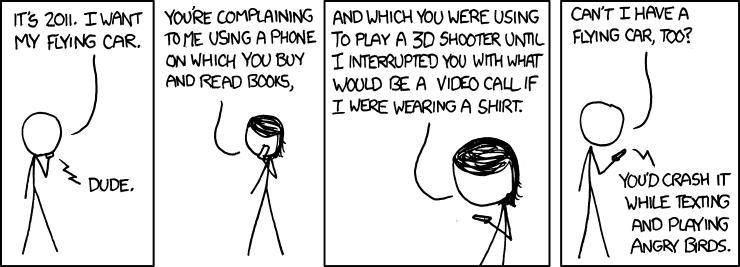
Some light relief from flying cars:
Permanent link to this comic: http://xkcd.com/864/

recapping the phd process

What i began with and where i have gotten to are different spaces.
I shouldnt be surprized, but the 'argument of a thesis' seems to suggest one starts here (problem) and gets here (recommendations).

And mine didnt do this.
Im studying change and what i notice is it only ever looks like a clean trajectory retrospectively.

What i began with was how to teach issues of heart and soul using IT.
By the time i got to colloquium I was advised just one of these would be enough, and by the time i had got to ethics application it had morphed and mushroom clouded into three separate studies, comparing professional with lay studies of how care is communicated through IT applications.

Getting real following this attempt to fly too close to the sun, and the process of writing the multiple ethics applications, had me falling out of the sky as my wings melted...

So after a serious and somewhat long talk with my very generous supervisor, i came down to earth; just one of these studies was enough. I remember we talked of which one would go the distance, would be 'sexy', would be the cure for cancer...

So i have an umbrella of studying change, and inside of this the use of emergent technologies in a community helpline, and this has of itself narrowed itself down to what evolved as most popular by the users of the service, being txt messaging for counselling.

Studying change as it occurs is like studying the blur...

I am now close to finishing...but have been at this stage for a year..i am rewriting the front end...and rewriting the back end...and rewriting.
My metaphor for this stage is a flatpack bicycle where every time i get the front end right, the back end no longer aligns and vice versa...but its getting closer, i think its beginning to look like if i 'rode it' it would no longer fall apart, the speed wobbles are less severe.

Interesting some of my most useful reading is what i have read after data is collected- reading i didnt even recognize as useful until i hit the wall, and then on rereading it made sense- and reading that i couldnt make sense of 5 years ago which is now comprehendable- and readings i didnt know i would need until the data analysis led me there- and some reading that wasnt even written when i began :)

And in writing when i hit a blind spot, sudden surprizes that blind me, i rewrite earlier bits while i let the current dazzle settle... had yet another fret about how to write of the research process and the sensitive ethics ...
The bits that are fast to write and the bits that are slow are utterly unpredictable.

Tuesday, February 22, 2011

Texting comes of age

Today the NZ Government is asking that people use text messaging instead of phoning loved ones in Christchurch.
(This is following a second significant earthquake in CHCH)
Seems SMS has reached a level of respectability, and is a preferred choice in emergencies.

Information from telecom:
The Christchurch 111 call centre has been successfully diverted to Wellington, and a back up site in Palmerston North is on standby if required. Issues connecting will be due to network damage, congestion or power-related issues.

Thursday, February 10, 2011

For Tom


Pilgrim Library Stained Glass, originally uploaded by Andrew|W.

What sunshine couldnt do without stained glass, nor stained glass without the light...
Living in a connected world matters, but i thinks its how we are shaped in connections that matters more.
A combination effect of relationality. Who I am and how I think, and what i learn is held in the network. The one does not happen without the other.
Such knowledge gained has this ephemeral quality, its held in the network; and does not hold the same shape when attempts are made to move it from here to there, such movement cannot help but shift it further.

On being in the prisms of possibility: from Thomas, a letter in reply

Reply
profesorbaker says:
February 9, 2011 at 1:18 pm

Hi Elise,

You are here with me today, as I was with you the past day, reading your writing.

Ailsa, you must know, that if I knew you, I would insist on calling you “Elise”, for that is the moment when your writing spoke to me, when your lovely voice first rose from the shadows of print surrounding it, and gave me the possibility of understanding what CCK11 means to me personally, when I first called you, “Elise”.

After reading your writing, I listened to this lovely pianist, playing your song, written centuries ago, and named, for you, “Für Elise”, “For Ailsa”, by Beethoven himself.

Yes, too much optimism, on anyone’s part, is a clear and present danger. On the other hand, a lack of optimism, a failure to believe that you can calm the wind, that you can sustain yourself over water, is also, a clear and present danger.

Only those crazy souls, who dare to dream that a man can fly, only those souls who see life not within the prism of its apparent limitations, but within the prism of its possibility, its potential, its “this-is-something-I-would-like-to-do-ness, and “why hasn’t someone done this before”, those are the ones who push the human race forward, I’ve been told.

Elise, we both agree on one thing, that life is beautiful, although scary at times, and if we strive for the beauty, I’m sure there will be music for us, even if we “be the only ones listening”, to Beethoven himself, playing your song, “Für Elise”…

Oh, Ailsa, your thesis is surely a majestic melody, and your smile, if it be like my smile, must surely last for a while….

My best regards, for my friend, Elise/Ailsa

Thomas

And: A letter to Thomas from Elise

Do you recall a letter written to Carl Rogers by Rollo May? It too asked that we consider relationality, for optimism alone may not be enough.

May, R. (1982). The problem of evil: An open letter to Carl Rogers. Journal of Humanistic Psychology, 22(10), 10-21. doi:10.1177/0022167882223003

Sometimes i get a little scared by too much positivity, a tyranny of niceness, a faith in connecting that assumes inherent goodness, and/or an evangelical regard for the wonders of machines that go ping.

Your post is very beautiful, eloquent and provocative…it has made me rewrite a part of my thesis writing, and has left me smiling most of the evening…it is also one of the most beautiful pieces of music ever made.
so i thank you, sincerely, ailsa

On: A letter to Elise

Ive kept a copy of our exchanges, and in trust i hope Tom does not mind.
But ive found before that a digital world is sometimes ephemeral, sometimes links no longer take me back to where i want to be, so this is a copy of an exchange held in the public spaces of our blogs.
I'd wrap them with a blue satin ribbon if i could, and place then somewhere precious for safe keeping, but the digital makes some things more and less possible.
Thomas' letter to Elise that followed my previous blog, on where the wild things are:

Hi Elise,

I liked a lot of things in your lovely post. I am a great one for “voice” and I listened to the “voice” present in this post of yours.

You (like me also) have looked at the criticism and controversy surrounding Connectivism as a theory of learning. Rather than turn to criticism, you turned to critique, doing the research required to present your points, well-supported, deliciously, eloquently offered to the reader, in this instance, myself.

Oh, the reading of your post was beautiful, and a measured voice, a reasoned voice, a wise voice emerged, to calm the wind, to view the water’s potential to hold us, if we but dare to walk upon it….

My point: Connectivism, as a Theory of Learning for a Digital Age, is not perfect, but perfectible.

In the meanwhile, a calm voice is appreciated, especially for those who defend the status quo, perhaps secretly fearing possible displacement by a digital age which is now demanding it’s own theory of learning.


No, I have erred. The digital age isn’t demanding anything. Real people are. “Who are these real people?”, you ask.

Digital learners. Digital learners, born in a digital age, the children of the digital age, the children of today, who will have to solve the world problems that you and I are leaving them as their lasting inheritance from us.

You see, you and I didn’t solve the problem of world hunger. As we sat at our tables yesterday, there were others who went to bed hungry.

You see, you and I didn’t solve the problem of world peace. As we watched the news on TV last night, maybe enjoying a pizza delivered by the home delivery service, there were people killing, and being killed, somewhere on this planet.

You see, you and I didn’t solve the problem of poverty. The children of the digital age have to live in a world where 1% of the world’s population has 80% of the world’s wealth.

Our digital children are a part of the 99% that’s fighting for a share of the 20% that’s left.

You see, you and I didn’t solve the problem of global warming.

While we talked about the appalling lack of scientific evidence to support such a claim, how Al Gore couldn’t be trusted, how the snow on Mt. Kilamanjaro disappeared in 2000 and came back in 2008 and disappeared again, how severe summers became the global norm, how wild whirlwinds whirled with regularity, and how the very Earth itself quaked incessantly in 2010, our weather and our planet simply became a bit more inhospitable for life itself, human life that is…

These are only a few of the problems we know we are leaving to the children of the digital age to solve. Their brilliance gives us reason to hope, to be optimistic about the future. But here’s the rub: what about those problems that we’re leaving the children of the digital age to solve, that we don’t know we are leaving to be solved?

You know, those problems that no one sees coming, the problems no one has thought about, no one has ever imagined? Will the education of the past century be up to that kind of task?

Listen to the digital age, for it speaks to us:

The digital age cries out: “Look at me! Look at my new clothes! Am I not more beautiful? Look at all my brilliant connections who share knowledge with me now!”

And we, the children of the last century, the vox populi, we too cry out: “We liked you the way you were dressed last year, ten years ago, last century! Was it not enough for you that I, and I alone, your teacher, poured my knowledge from my brain into yours?


Connections? Bah, humbug!

Who needs connections when you have me? Take those new clothes off! Come into my classroom, turn off that cellphone, put away your digital toys, turn off that blasted computer, no YouTube, no Skype, no instant messaging, no social media for you. By Jove, this is a classroom! We are doing education in here! Get in your seat, second row, third desk, behind student number 33.”

Teacher (smiling) “Good morning class. Today I will be telling you all about…”

Connectivism: A Theory of Learning for a Digital Age, is playing catch-up to Connectivism: the Practice of Learning in a Digital Age.

The transformation, the paradigm shift, the revolution, the reformation, call it what you will, but it has already happened.

We are not Einstein, we are not Newton, we are not the makers of the wheel.

No, we are simply describing the wheel: It’s round and it makes getting from Point A to Point B a heck of a lot more enjoyable.

We’ve already been hit on the head by the apple, gravity has happened, and now we explain why that apple fell down, on our heads, rather than rise into the sky…

E = MC squared? Now that was a tough sell, wasn’t it? But if Einstein could do it, working alone in a patent office, a-l-o-n-e, connected to no one but himself, then what do you think Mankind, the children of the digital age, will do, when they connect and share their knowledge?

Oh, I would think that they will solve problems that we children of the past century could not, or would not, solve…

Best regards,
Thomas

Monday, February 07, 2011

Where the wild things are: Connectivism, CCK2011#


This unpolished rant was brought on by wikipedias flame wars on connectivism as well as by Latour's and Law's discussions as to whether Actor-network theory is a theory or not.

I always thought philosophy and theory were a matter of scale; the one grander, more over reaching, and the other more grounded, more empirically tested. That the philosophy required internal consistencies a complex arrangements of how the world is seen and constructed and so can make meaning of the world.

Isn't philosophising about what ontologies, epistemologies,are? what is knowledge and how is it known...and in talking philosophy down to earth, what produces the 'good life' which is essentially contestable? While theorizing is more grounded in day to day practicalities?

Kurt Lewin suggests there is nothing so practical as a good theory.
So a theory gets tested in empirical research, in application, in my view it is not necessarily predictive, though this is the stance of 'scientific method' that it be repeatable and so provide consistency... case studies too can provide more and less support, more or less weakening of a theory.

In philosophising a good philosophy, paraphrasing John Dewey (1958) in Experience and Nature:

“Does it end in conclusions which, when they are referred back to ordinary life experiences, render them more significant, more luminous to us, or make our dealings with them more fruitful? Or does it terminate in rendering experiences more opaque than they were before?”

So I'm thinking ANT is philosophy. And at its finest :)
Its descriptive, and there are empirical accounts
But its not predictive.
It does not over-reach itself.
It illuminates knowing this also creates shadows: a self-conscious theory.
But importantly it meets Dewey's account for being fruitful, for creating the conditions of also knowing that things might be otherwise.

For connectivism, it's still establishing its clarity, its alignments, its contradictions, its loves and betrayals. But theory does not come into the world brand spanking new ready to go...its a little unfair to treat it in the same ways one might treat an adult or a teenager, when its still toddling. And a toddlers survival is not just about it's own robustness, it's also about the readiness of others to engage in more and less supportive ways.

Law in a sociology of monsters describes the newness of things also, citing a story
I said 'I think they might also be called "hopeful monsters".'
She said' What are hopeful monsters?'
I said 'They are things born perhaps slightly before their time; when it's not known if the environment is quite ready for them.' Nicolas Mosley, Hopeful Monsters, p.71

So let us not forget readiness is a distributed state also. A networked proviso.

I now turn to how criticism might be enhanced taking a relational approach.
Latour suggests in doing research one should always be respectful of one's informants/participants/people we work with...and as much as reasonably possible:
Always assume people are right, even if you have to stretch the point a bit. A simple rule, my dear pupil when you're studying a project. You put yourself at the peak of enthusiasm, at the apex, the point when the thing is irresistible. (p.36)
No reason we should not be so generous to newer theorists and theories in the making. They are not attempts to deceive.

And like Donna Haraway, to say, from a distance, that one knows better, is to see everything from nowhere as one's own situated knowledge is not acknowledged but treated as a gospel truism. Some reflective work on one's own positioning and how one positions others in the network might be useful here. A network is not a hierachy. There is no one at the top with a supreme world-view, instead accepted wisdom (knowledge) is also made and distributed on a network.

I take an ANT stance with this, being connected means being in relationship, so what would happen were the question treated relationally? In considering critique instead of criticisms, if instead of thinking is this good/bad/right/wrong we were instead to consider, what does this bring to the relationships with others (human or otherwise): then not only might it illuminate, and render less opaque as Dewey would ask, but perhaps we might also ask in what ways might that which is looked at, as well as the theorizing undertaken, be otherwise?

The following is a beautiful piece of prose on the type of criticism yearned for by one philosopher, from an anonymous interview titled the masked philosopher:
"I cant help but dream about a kind of criticism that would try not to judge but to bring an oeuvre, a book, a sentence, an idea to life: it would light fires, watch the grass grow, listen to the wind,, and catch the sea foam in the breeze and scatter it. It would multiply not judgements but signs of existence; it would summon them, drag them from their sleep. Perhaps it would invent them sometimes- all the better. All the better. Criticism that hands down sentences sends me to sleep; I'd like a criticism of scintillating leaps of the imagination. It would not be sovereign or dressed in red. It would bear the lightening of possible storms."

The masked philosopher was Foucault 1994, p. 326

To yearn for such criticism is to yearn for engagement, to enquire, and not to close down, but to foster connections...such that new learning might occur.

I don't know if i believe in connectivism as a new theory of learning, but what i do know is a connected world makes learning occur in ways that would previously have been very difficult. Technologies bring about new ways of being in relationship, and no learning is possible without relating.

Ref:
Dewey, J. (1958). Experience and nature. New York, NY: Dover Publications.
Michel Foucault, interviewed anonymously in Le Monde by Christian Delacampagne, April 6–7, 1980; reprinted in M. Foucault, Ethics, Subjectivity and Truth (ed. Paul Rabinow, tr. Robert Hurley et al.), The New Press, New York, 1994.
Haraway, D. (1988). Situated knowledges: The science question in feminism and the privilege of partial perspective. Feminist Studies 14(3), 575-599.
Latour, B. (1996). Aramis: Or the love of technology (C. Porter, Trans.). Cambridge, MA: Harvard University Press.
Law, J. (Ed.). (1991). A sociology of monsters: Essays on power, technology and domination. London, England: Routledge. Retrieved from http://books.google.co.nz/books?id=FsINAAAAQAAJ&printsec=frontcover&dq=A+sociology+of+monsters:+Essays+on+power,+technology+and+domination&source=bl&ots=PN2gGPt9al&sig=Y1kZy4EfVYcqKssYcB-J9L5zZ_8&hl=en&ei=XRHKTPfyJYfcvwPyl5nWDw&sa=X&oi=book_result&ct=result&resnum=1&ved=0CBUQ6AEwAA#v=onepage&q&f=false

Friday, January 21, 2011

The comma as a fashion victim

I know about apostrophe abuse and try not to perpetuate this violence.
However, it is comma neglect that disturbs me more.
Apparently, they are not as well loved as they once were. They are, apparently, fading from fashion.
Let's be clear on this; abuse by neglect is still abuse.

The following proves my point:

Thursday, January 20, 2011

Material girl looking to give up on mastery in search for fidelity

I just love the writing of Patti Lather as she cites Donna Haraway, and Serres
resonates well with my current quandaries.

Messing with reality: troubling a lineal approach by tangling myself up :)

Lather cites Serres in addressing a code of practice for messages-
"Easy to spot the problem, hard to supply the ethic!" (Serres 1995, p. 101)
His answer is a kind of presence and absence and presence again (Serres, 1995, p.104)


Circumspact, convoluted and sometimes seemingly perverse. A fragmented montage method of argument

cites Neitszche " my theory grows from my practice- oh, from a practice that is not by any means harmless or unproblematic (1967,p.340)

The work of methodology to negotiate the politics of knowing and being known. Method resituated as a way into the messy doings of science via risky practices remade in every situated enquiry

Working the ruins of a confident social science;
as the very ground from which new practices of research takes shape

This books works at cancelling distance between reader, writer and written about.

Ref
Lather, P. (1997). Creating a multilayered text: Women, AIDS, and Angels. In W. G. Tierney & Y. S. Lincoln (Eds.), Representation and the text: re-framing the narrative voice (pp. 233-258). New York, NY: State Univeristy of New York Press.

Tuesday, January 18, 2011

on being textually tangled

I didnt have a language for it...
tongue tied
I ponder being textually tangled.

Reading around I knew i wasnt alone...
many feminist writers...
many other ways of approaching it...
and then there's a matter of deciding how much is enough vs how deep such oceans of exploration and thinking might be.

This late in my canditure i do not have the time to drown anew
As if one ever does.
(Reminds me of a powerful thesis i once read ...
power defined as the capacity to still unsettle 4 yrs later, it quoted a poem of not waving, drowning)

A prompt from Jane Davis http://bit.ly/eAfo9Z on twitters #Phdchat had me rereading
The thesis whiperer, and Inger's post names it for me, it's what happens with threshold concepts.
here's mine;
Voice.
Cant give it- disempowering.
Cant hear it and assume the story is captured...stories change.
Cant write it, it stabilizes something that is constantly in motion

So feeling like Im on a bear hunt: cant go over it, cant go under it, glossing it didnt work, ignoring it didnt either... the way is through it:
and for want of a better phrase i borrow from Patti Lather on both do-ing it and troubling it

So today was only a few words day instead of my goal of 333
And quite a few hundred or so words got binned...
but at least todays new words made sense of several thousand more that came before and after
:)

ref
Lather, P.(2001).Postbook: Working the Ruins of Feminist Ethnography.Signs p.199-227
http://www.jstor.org/stable/3175873

and commentary on
Troubling the Angels, working with women living with HIV/AIDS

The approach she talks of is similar to the discontinuous writing style i had already decided on via ANT and authors Latour, Mol, and Law.

CCK11 Revisiting Connectivism as a theory of learning

Bother, cant make a table work here...cant share whats in my head when the actor i ask to carry it to others ... blogger ... turns it into scrambled eggs.

A translation too far.
Now I'm talking to myself
An iterative process.. engaging with the technology, the thoughts of others....the docs...

I need a space to put a pdf ... that others might link to...
could play on prezzie... but my fledgling prezzie skills would take me too long...

mmm...managed it there as not quite scrambled eggs...cant make a table that behaves...sizes and columns...
ah...deleted most...some wont go away but layering a pdf on top covers up my mess......see http://prezi.com/gebyyxino6og/cck11-meets-ant/
You can click on the prezzie below and zoom in
Please feel free to adapt further, make an attribution to me if you use it...
and invite me to come look...

Adapted from a table George Siemens has on learning theories in week 1 readings, but with an additional column expanding on connectivism to consider actor-network theory
I dont have the time to present it in a more engaging, enticing way, feel free... please feel free to become an actor in my network...or to make me one in yours :)

Im back to the phd